

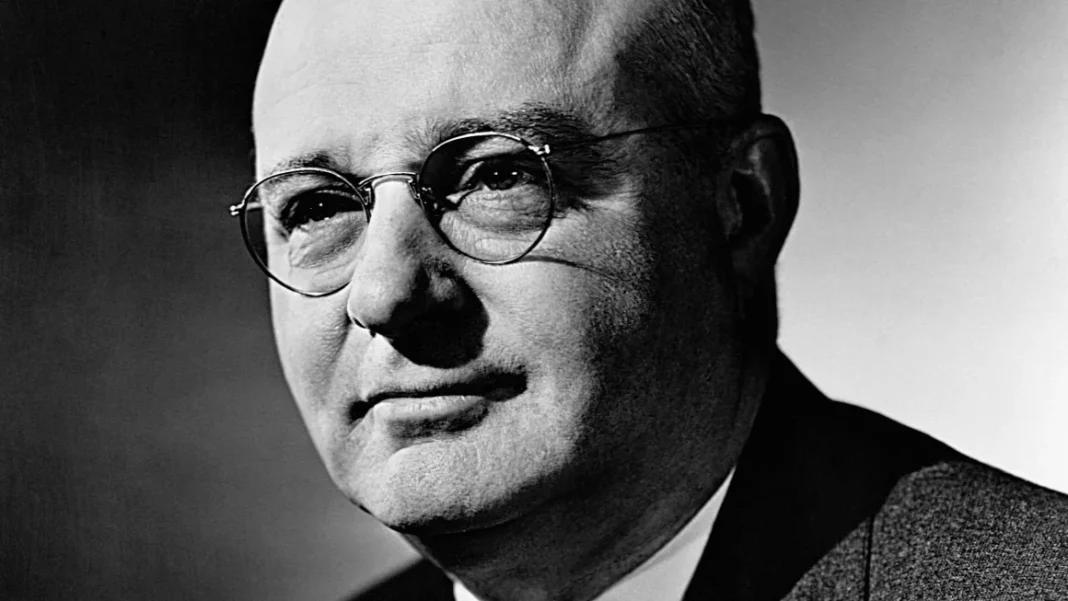

Facing a crowd of journalists, inventor Thomas Midgley Jr. poured a lead additive over his hands and then proceeded to inhale its fumes for about a minute. Unfazed, he said, “I could do this every day without getting any health problems whatsoever.”
Soon afterward, Midgley needed medical treatment. But the act would have dire consequences beyond his own well-being.
The year was 1924, and Midgley, then a chemical engineer for General Motors, had pulled the stunt to support his most recent, lucrative finding: a lead compound called tetraethyl lead. Added to gasoline, it solved one of the biggest problems the automotive industry faced at the time — engine knocking, or tiny explosions in car engines due to the low quality of gasoline that resulted in an annoying sound and potential damage. Lead helped, but at great expense, because the substance is highly toxic to humans, especially children.
Midgley would go on to leave his mark in history with another destructive invention, also a solution to a problem: the need to replace the noxious and flammable gases used in refrigeration and air conditioning. He found that CFCs, or chlorofluorocarbons, were an ideal substitute and harmless to humans. However, they turned out to be deadly to the ozone in the atmosphere, which blocks dangerous ultraviolet radiation that can cause skin cancers and other health problems, as well as harming plants and animals.
One hundred years after that stunt before the press in 1924, the planet is still recovering from the ill effects of both of Midgley’s inventions. The ozone layer will need another four decades to heal fully, and because leaded gasoline was still sold in parts of the world until 2021, many continue to live with the long-term effects of lead poisoning.
Yet Midgley — whose story will be told in an upcoming movie developed by the writer of the 2013 film “The Wolf of Wall Street” — was hailed as a hero for decades.
An inventor from his early days
Born in Beaver Falls, Pennsylvania, in 1889, Midgley had a penchant for finding useful applications for known substances early on. In high school, he used the chewed bark of the slippery elm trees to give baseballs a more curved trajectory, a practice professional players would later pick up.
He was known to carry with him at all times a copy of the periodic table, his main tool in the search for the substance that would mark his breakthrough invention.
The task of addressing the issue of engine knocking fell to Midgley while he was working at General Motors in 1916.
“It was the dawn of the automobile era in the United States, and Ford had developed the Model T, which was not very powerful,” said Gerald Markowitz, a history professor at the City University of New York. “GM joined with Standard Oil and DuPont to try to develop more powerful engines, and in order to do that they needed to solve the problem of the engines knocking with the fuel that they had at the time.”
Under the direction of Charles Kettering, another influential American inventor and head of research at GM, Midgley worked his way through thousands of substances — including arsenic, sulfur and silicon — in a quest to find one that reduced knocking when added to gasoline. He eventually landed on tetraethyl lead, a lead derivative that was marketed simply as Ethyl. Leaded gasoline first went on sale in Dayton, Ohio, in 1923 and eventually spread throughout the world.
Lead is highly poisonous, with no safe level of exposure, and can impair development in children, causing decreased intelligence and behavioral disorders, according to UNICEF. An estimated 1 million people a year still die from lead poisoning, according to the World Health Organization.
The toxicity of lead was already well-known when Midgley added it to gas, but that didn’t stop Ethyl from becoming a commercial success.
“There were alarms that were raised, because lead was known as a toxin,” Markowitz said. “But the position of the industry was that there was no proof that lead coming out of the tailpipes of cars was going to injure people. And it was that lack of proof that ultimately led the surgeon general not to take action after a public health conference in 1925.”
However, workers in Ethyl manufacturing quickly experienced ill effects.
“It was really the fact that the people working in the labs producing tetraethyl lead were getting sick that created a crisis,” Markowitz said. “They would literally go insane as a result of their exposure to lead.”