
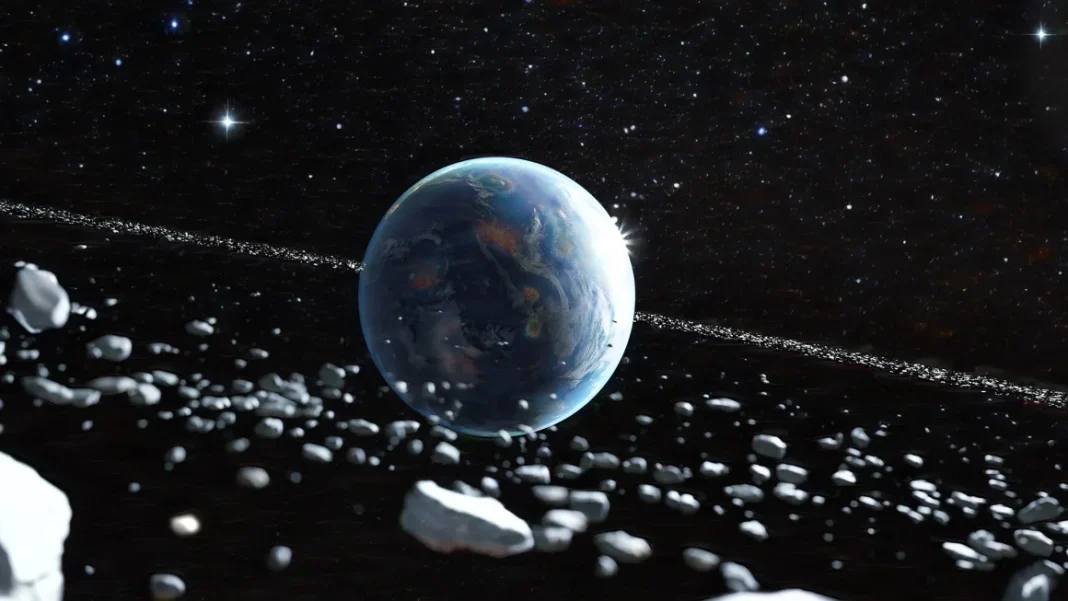

Famously known for its extensive ring system, Saturn is one of four planets in our solar system that have the distinctive feature. And now, scientists hypothesize that Earth may have sported its own ring some 466 million years ago.
During the Ordovician Period, a time of significant changes for Earth’s life-forms, plate tectonics and climate, the planet experienced a peak in meteorite strikes. Nearly two dozen impact craters known to occur during this time were all within 30 degrees of Earth’s equator, signaling that the meteoroids may have rained down from a rocky ring around the planet, according to a study published September 12 in the journal Earth and Planetary Science Letters.
“It’s statistically unusual that you would get 21 craters all relatively close to the equator. It shouldn’t happen. They should be randomly distributed,” said lead author Andrew Tomkins, a geologist and professor of Earth and planetary sciences at Monash University in Melbourne, Australia.
Not only does the new hypothesis shed light on the origins of the spike in meteorite impacts, but it also may provide an answer to a previously unexplained event: A global deep freeze, one of the coldest climate events in Earth’s history, may have been a result of the ring’s shadow.
Scientists are hoping to find out more about the possible ring. It could help answer the mysteries of Earth’s history as well as pose new questions about the influence an ancient ring could have had on evolutionary development, Tomkins said.
A Saturn-like ring on Earth
When a smaller object gets close enough to a planet, it reaches what’s known as the Roche limit, the distance where the celestial body has enough gravitational pull to break apart the approaching body. The resulting debris then creates rings around the planet, such as those around Saturn that may have been formed by debris from icy moons, according to NASA.
Scientists previously believed that a large asteroid broke apart within the solar system, creating the meteorites that hit Earth during the Ordovician Period. However, such an impact would have likely caused the strikes to be more randomly distributed, such as the randomization of the craters on the moon, Tomkins said.
The study authors hypothesize that a large asteroid, estimated to be about 7.5 miles (12 kilometers) in diameter, instead reached Earth’s Roche limit, which might have been about 9,800 miles (15,800 kilometers) from the planet based on the measurements of past rubble-pile asteroids. The asteroid would have been largely beat up from other collisions, making rubble loose and easy to pull apart by Earth’s tidal force, Tomkins said.