

BBC
In Aleppo’s city centre, the huge billboard in the main square with a picture of President Bashar al-Assad, which used to be a feature in any Syrian town and village, was set on fire, then removed.
The red, white and black national flags that decorated the lampposts were also taken away and replaced with what is known as “independence flag”. Down the road, outside the city hall, a giant banner with a photo of Assad was taken down; another had his face riddled with bullets, and for whatever reason was being kept there.
Across Aleppo, residents and the new authorities seemed eager to get rid of anything symbolising the Assads – Bashar had come to power in 2000 after the death of his father Hafez, who ruled for 29 years.
I came to Aleppo for the first time as a student, in 2008, and banners with Assad’s face were prominent in public squares, streets and government buildings; all of them seemed to have been either removed or destroyed.
This was the first major city captured by Islamist-led rebels earlier this month, in their astonishing offensive that overthrew Assad and brought freedom to this country after five decades of oppression – at least for now.
One of the first things they did was to topple a large equestrian statue of the former president’s late brother, Bassel; a statue of Hafez was also vandalised.
Once a bustling commercial hub, Aleppo witnessed, and was ravaged by, intense battles between opposition fighters and government forces during the civil war, which started in 2011 when Assad brutally repressed peaceful protests against him.
Thousands were killed. Tens of thousands more fled.
Now, with Assad gone, many are coming back, from other parts of Syria and even abroad.
People are begining to return to the public spaces of Aleppo
Early in the war, East Aleppo, a rebel stronghold, was besieged by forces loyal to the regime and came under intense Russian bombardment. In 2016, government forces reclaimed it, a victory then considered a turning point in the conflict.
To this day, buildings remain destroyed, and piles of rubble wait to be collected. The return of the Assad forces meant that it was too risky for those who had fled to come back – until now.
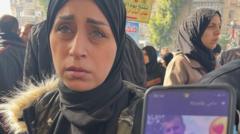
“When the regime fell, we could raise our heads,” Mahmoud Ali, who is 80, said. He left when fighting there intensified in 2012. He moved with his family to Idlib, in the country’s north-west, which, until two weeks ago, was the rebel enclave in Syria, run by Hayat Tahrir al-Sham (HTS), the group that led the anti-Assad offensive.
“Repression is what I say all my life in the hands of the Assad family. Anyone demanding any rights would be sent to jail. We protested because there was a lot of repression, especially on us, the poor people.”
His daughter, 45-year-old Samar, is one of millions in Syria who had only known this country being ruled by the Assads.
“Up until, nobody dared to speak up because of the terror of the regime,” she said.
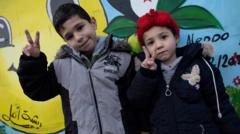
“Our children were deprived of everything. They didn’t have their childhood.”
It is remarkable that these feelings were being shared so freely in a country where opposition was not tolerated; the secret police, known as the Mukhabarat, seemed to be everywhere and spying on everyone, and critics were disappeared or sent to jail, where they were tortured and killed.
Across Aleppo, the new authorities installed billboards with the image of chains around two wrists saying, “Freeing detainees is a debt upon our necks”.
“We’re happy, but there’s still fear,” Samar said. “Why are we still afraid? Why isn’t our happiness full? It’s because of the fear they [the regime] planted inside us”.
Her brother, Ahmed, agreed. “You could be sent to jail for saying simple things. I’m happy, but I’m still concerned. But we’ll never live under repression again”.
His father intervened, to agree with him. “That’s impossible.”
The family lived in a small flat, where electricity was intermittent and heating, inexistent.
Now that they had returned, they did not know what to do, like many others here. More than 90% of Syria’s population is estimated to live in poverty, and there are broader concerns about how HTS, which started as an al-Qaeda affiliate, will run the country.
A woman who lived in a flat nearby said, “No-one could take away my happiness. I still can’t believe that we came back. May God protect those who took the country back.”
At the main square, a man told me, “I really hope we get it right, and there isn’t a return to violence and oppression.”
At Mahmoud Ali’s flat, an “independence flag”, with its three red stars in the middle, had been drawn on a white paper, and put on the coffee table in the living room.
Samar, one of his daughters, told me, “We still can’t believe that Assad is gone.”