


Bayeux Tapestry arrives in UK for first time in 900 years under police guard
Figure caption, Watch: 1,000 year-old Bayeux Tapestry arrives at British Museum
By
Culture and Media EditorReporting fromThe British Museum
The Bayeux Tapestry has arrived in the UK, for the first time since it is believed to have been created here nearly 1,000 years ago.
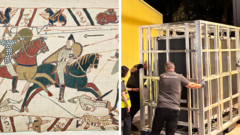
At 02:50 BST, chaperoned from a secret location in northern France by a police guard, it was driven into a loading bay at the British Museum, which will put it on display in September.
The 70m-long 11th Century embroidery depicts in 58 scenes events leading up to the Battle of Hastings and Norman Conquest of England in 1066 – the moment that changed the country forever.
The heavy-looking crate, encased in an aluminium frame, was lowered out of the lorry in front of a select crowd including the French ambassador to the UK and the director of the British Museum.
Nick Cullinan, the director of the British Museum, told me: “We’ve just witnessed something rather extraordinary, which is the arrival of the Bayeux Tapestry at the British Museum but specifically it is returning to England for the first time in almost 1,000 years.
“It feels like a really remarkable thing not just to witness but to be part of, and we’re so excited to share it with as many people as possible.”
A big black crate being removed from a lorry in the dead of night may not sound that exciting but this is a historic moment – and BBC News was also there to witness it.
Millie Horton-Insch, project curator of British Museum Bayeux Tapestry exhibition, said: “It probably sounds a bit strange to be that excited at seeing a lorry reverse into a loading bay and a box removed, but when you consider the object within it, how old it was, how close to the events it depicts it was made, by people who lived through those events, it’s really profound.
“I did well up a little bit when I saw it coming off the lorry so I imagine I’ll probably be in floods of tears when I actually see it.”
Image source, British Museum
Image caption, The British Museum projected the word “merci!” onto the white cliffs of Dover
French President Emmanuel Macron said in the Times, external that the loan was “a gesture of trust, a tangible expression of a long-standing friendship and a sign of our shared desire to see France and the United Kingdom build their future together”.
He earlier posted a photograph of an image of the Bayeux Tapestry which the British Museum had projected on to the white cliffs of Dover. On the image was “merci” (thank you).
But in France ever since the announcement, there has been some disquiet that a work of such fragility and historical importance was to go on loan more than 300 miles away. A French petition to stop it called it a “heritage crime”.
Even artist David Hockney, before his death, said that he did not think it should come to the UK because moving it could put it in jeopardy. “Some things are too precious to take a risk with,” he wrote.
Image source, The Making of Heritage in Normandy, Antoine Cazin
Shock absorbers and practice runs – how it was moved
To ensure it travelled safely – and without damage – the folding stand, which the tapestry has been kept on since it was taken down from display in Bayeux last year, was put inside a crate, with temperature and humidity regulation. That crate was then placed into an outer cage, in which metal springs acted as shock absorbers to protect it from bumps in the road.
The work travelled across the Channel on the Eurotunnel before making its way to central London in the dead of night.
Cullinan told me: “If anybody had said on the other side, especially on the French side as the lenders, ‘I think this is too risky to do’, it wouldn’t be arriving now. That’s the reality. A museum would never do something that imperilled the objects in its care.”
No damage is “the goal”, he added. “That’s what all the care has gone into trying to achieve and we feel very confident about that. And the thing to say too is much more fragile things travel all the time. We lend more fragile things.”
Image caption, The tapestry arrived in a heavy-looking crate, encased in an aluminium frame
Two practice journeys with a textile copy were previously made, to test the route and the crate. The point was to measure the vibrations and reduce any major impact or shock.
Peter Ricketts, the UK special envoy for the loan of the tapestry, said: “everything possible” had been done to avoid damage.
“No-one would want to bring the tapestry to the UK if they thought there was any damage or danger to this extraordinary object. I’m not worried, I’m relieved. It looks like all those meticulous arrangements for the transport are working very well.”
He described the loan as “two old nations coming together to look at their shared history and that is very special”.
The Bayeux Tapestry’s epic story
The Bayeux Tapestry is not actually a tapestry at all: it is linen with embroidered pictures of the tussle between William, Duke of Normandy then Conqueror of England, and Harold II, King of England, stitched on in coloured woollen yarn.
An embroidery of immense significance – 58 scenes, 626 characters (but only six women), 202 horses – ships, swords and arrows (including one hitting the soldier believed to be Harold II – although there are questions about whether this was added later).
Horton-Insch said it was a “miracle” that the artwork had survived for more than 900 years. “Moths, mice, damp, mould, fire any number of things” could have wrecked it.
“It is just an extraordinary survival.
“It tells the story of one of the most consequential moments in English history, British history, in the most incredibly vivid way that just can’t be captured in written sources.”
The Bayeux Tapestry is an epic depiction of the end of Anglo-Saxon England.
The Norman Conquest changed everything, reshaping the country entirely. English lands were handed over to the Norman nobles. The Normans built hundreds of castles which secured their control and projected royal power.
English earls were replaced with Normans, as were senior members of the Church.
And thousands of French words that we still use today entered the English language – everything from law, parliament and justice to mutton, beef and pork.
The tapestry gives an account of the medieval period in Normandy and England like no other. It provides information about civil and military architecture, armour and seafaring in the Viking tradition, as well as precious details of everyday life.
Before 1066, the nation’s cultural and political ties were to Scandinavia and the North Sea. After the Norman conquest, it became part of a Norman realm stretching across the English Channel. It is sometimes said to be the start of England’s involvement in continental European politics.
The nine-month loan is backed by the French government in an agreement finalised between Macron and UK Prime Minister Sir Keir Starmer last year. The museum in Bayeux, Normandy, where it has been exhibited since 1983, is closed for renovation.
At the time the loan was announced, former chancellor George Osborne, chair of the British Museum Trustees, said: “Once in a generation there’s a British Museum exhibition that eclipses all others. Think in previous ages of Tutankhamun and the Terracotta Warriors. The Bayeux Tapestry will be THE blockbuster show of our generation. I know it will capture the imagination of an entire nation.”
In return, the British Museum is loaning treasures including from the Sutton Hoo hoard as well as the Lewis chess pieces, made from walrus ivory in the 12th Century.
The excitement about the tapestry going on display saw the British Museum sell a record 100,000 tickets on the first day of sales. The work will be displayed flat – a requirement of the loan. A mezzanine will allow visitors to see the work in its entirety as they walk into the gallery – for the first time in history.
But before that come weeks of painstaking examination of the work following its journey.
Get our flagship newsletter with all the headlines you need to start the day. Sign up here.
Related topics