

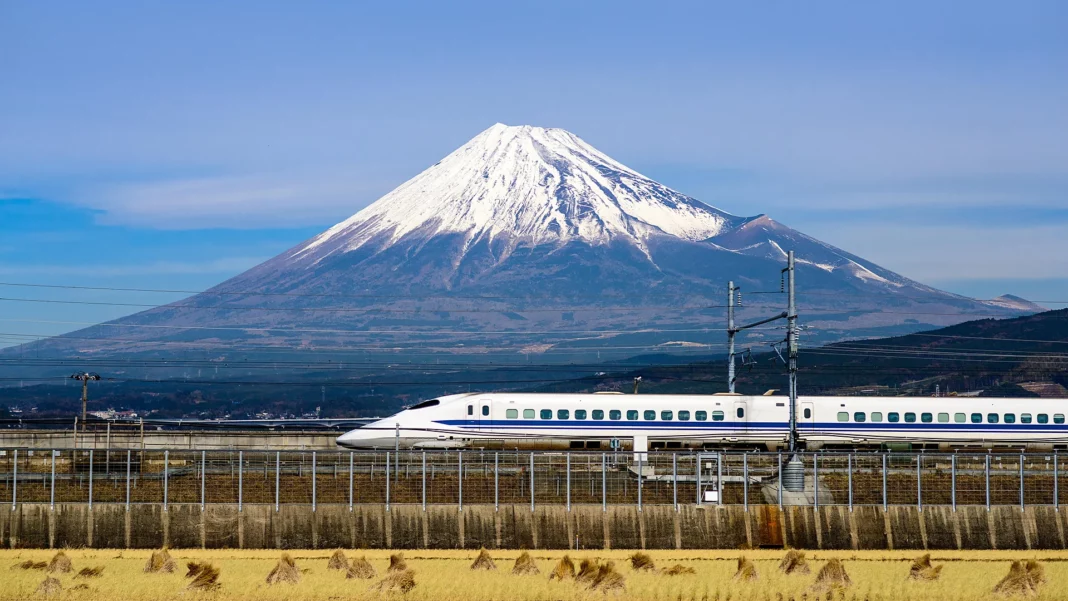

Sixty years after the world’s first high-speed train launched, rail enthusiast Paul Carter rides the bullet train along what’s been dubbed the “New Golden Route”.
Standing on platform 19 at Tokyo Station, a bustling cathedral to modern rail travel, it’s hard to believe that it was 60 years ago this year that the first Shinkansen train departed from here, bound for the port city of Osaka.
Instantly recognisable for its striking, sloping nose and sweeping aerodynamic curves, the Shinkansen was the world’s first high-speed train and quickly became known around the world by its English-language moniker: the bullet train.
That high-speed line between Tokyo and Osaka – the Tokaido Shinkansen – became known by travellers as “The Golden Route”, whisking passengers between two of Japan’s great cities as it passed by the splendour of Mount Fuji and the ancient capital of Kyoto in less than two and a half hours.
Amidst the crowds of people boarding and alighting Shinkansen trains (which are known for their to-the-minute precision), I met with Naoyuki Ueno, a former Shinkansen driver who is now a senior executive at Central Japan Railway Company. He told me that since the train’s introduction, it has carried a staggering 6.8 billion passengers across Japan.
“I’m proud of the Shinkansen,” he said. “As a Japanese citizen I’m proud of that.”
Since that first route opened in 1964, the Shinkansen network has expanded greatly, making it much easier (and quicker) for travellers to explore the nation’s dramatic landscapes and far-flung cities. There are now nine Shinkansen lines across the country, covering the islands of Hokkaido, Honshu and Kyushu.
In March 2024, the most recent extension to the Hokuriku Shinkansen line opened, connecting the route to Tsuruga. The Hokuriku line has been dubbed “The New Golden Route”, and it formed the basis of my journey from Tokyo to Osaka as part of the BBC series The World’s Greatest Train Journeys. I used the Shinkansen as the backbone of my journey, but also connected with other local services and lines. Part of the brilliance of the bullet train is that it can whisk you out of a city in what feels like no time at all, giving you the freedom to quickly explore off-the-beaten-path corners of Japan.
Stepping off the Shinkansen in Toyama, just two hours from Tokyo, I took a small single-line train to the stunning resort town of Unazuki Onsen. Famous for its traditional Japanese hot springs (onsen) and nestled in the breathtaking surroundings of the Kurobe Gorge, it felt a million miles from the frenetic pace of the Tokyo metropolis. The springs are so synonymous with this town that there is even a hot foot spa at the end of the train station’s platform.
My guide, Hashimoto Yukinori, or “Yuki”, invited me to one of his favourite onsen in the town, with sweeping views across the valley. He explained to me that, traditionally, onsen are normally taken naked and communally. (Thankfully, for the sake of the global television audience, we were given special permission to wear swimsuits, something that would usually not be allowed.) Relaxing as they are, onsen aren’t for the faint-hearted: the water was around 40C, and Yuki said sometimes they can be hotter.