

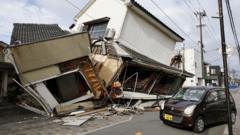

Business was winding down for the day at Sendan Shokudo, a diner in Japan’s southwestern city of Yatsushiro, when the whole building suddenly lurched.
Everything on the kitchen shelves cascaded to the floor; bowls and glasses shattered.
The restaurant’s co-owner, 75-year-old Hiroko Ogata, had just walked in.
“I was surprised, and scared,” she told BBC News. “I went under one of the tables right away, but the table moved sharply towards the right, left, right, left, with me.”
Ogata has lived in Yatsushiro, in central Kumamoto prefecture, her whole life.
The area is located on an active tectonic fault system and is no stranger to tremors. In 2016, a pair of earthquakes killed 277 people and injured 2,800 others.
But Ogata has “never experienced this big of a jolt”.
“The last quake 10 years ago was nothing like this one,” she said. “I thought I would die.”
At least 13 people have been killed in the wake of the 6.8-magnitude earthquake that hit Kumamoto late on Tuesday.
Of that number, three died in the Aeon shopping mall in Kumamoto city, where dozens are still believed to be trapped.
Rescue efforts are underway, but Prime Minister Sanae Takaichi has warned that emergency services are in a “race against time”.
Just a few hundred metres away from the Aeon mall, Yui* was sitting in the back office of her cake shop when the quake hit.
“I couldn’t tell which was the sound of the earthquake and which was the sound of the explosion,” she told the BBC.
“All I could do was hold the chair I was sitting in as big jolts came one after another,” she added, appearing to still be in shock.
“I didn’t know what to feel; I couldn’t even feel scared in such a situation. Even now I don’t know what to feel, and I don’t know how to explain.”
Authorities and emergency responders mobilised quickly. Shortly after the tremor struck, Takaichi put 4,600 personnel on the ground to assist with recovery, and said that teams would work “tirelessly through the night” to assess and monitor the damage in affected areas.
Despite this, tens of thousands of people have experienced power and water outages across Kumamoto City and at least 45 medical facilities have been damaged.
The exterior walls of the 17th century Kumamoto Castle, in the city’s centre, came toppling down in a plume of dust. The worship hall of the 19th Century Yatshushiro Shrine completely collapsed.
In the meantime, locals like Ogata and Yui* are having to pick up the pieces and try to restore some kind of normality – even as the shockwaves, both geological and psychological, continue to quiver.
“The whole of my place is messy, and I don’t know where to stand – but we have to earn our living by restarting our restaurant as soon as possible, so I am cleaning the place today,” Ogata said on Wednesday.
“But when I try to work for a bit, an aftershock occurs and I have to stop – then I do some work and we have another aftershock… So it is going so slowly.
“If we keep having this many aftershocks it will be very stressful.”
Yui’s cake shop remains closed, as she assesses the extent of the damage.
“I haven’t checked whether the machines such as the oven are working,” she said. “After I check those, I will have an idea whether I can go back to business or not.”
*Names have been changed