

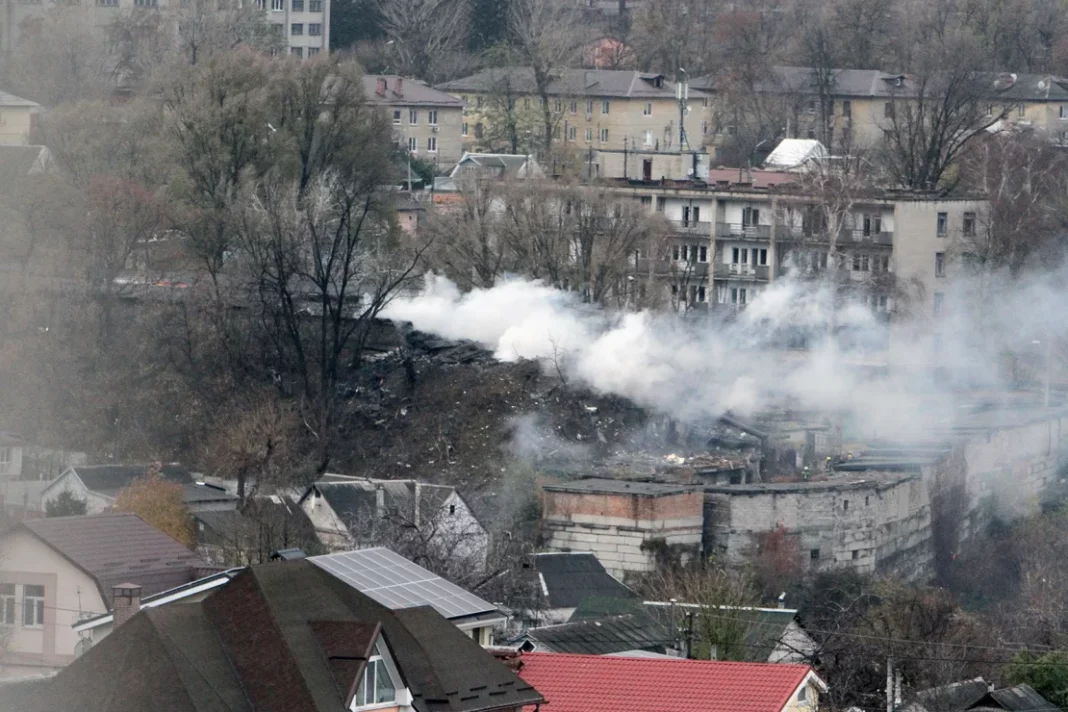

Russia’s use of a nuclear-capable ballistic missile on Thursday is the latest escalation in the Ukraine war.
It also marks a decisive, and potentially dangerous moment in Moscow’s conflict with the West.
The use of what Vladimir Putin said was a ballistic missile with multiple warheads in offensive combat is a clear departure from decades of the Cold War doctrine of deterrence.
Ballistic missiles with multiple warheads, known as “multiple independently targeted reentry vehicles,” or MIRVs, have never been used to strike an enemy, experts say.
“To my knowledge, yes, it’s the first time MIRV has been used in combat,” Hans Kristensen, the director of the Nuclear Information Project at the Federation of American Scientists, said.
Ballistic missiles have been the underpinning of deterrence, offering what is known as “mutual assured destruction,” or MAD, in the nuclear age.
The thinking is, if even a few missiles survive a nuclear first strike, there will be enough firepower left in the opponent’s arsenal to wipe out several major cities of the aggressor, therefore ensuring neither side is unable to escape the consequences of nuclear actions.
In that vein, ballistic missiles were designed to stand sentinel over a future where nuclear arms would never again be fired in anger.
But analysts, including Kristensen, argue that MIRVed missiles may invite, rather than deter, a first strike.
The highly destructive capacity of MIRVs means that they are both potential first-strike weapons and first-strike targets, Kristensen and colleague Matt Korda at the Federation of American Scientists wrote in a study published in March.
That’s because, it’s easier to destroy multiple warheads before they are launched, than try to shoot them down as they are dropping at hypersonic speed on their targets.
And according to a recent posting from the Union of Concerned Scientists, a US-based nonprofit science advocacy organization, this creates a “use them or lose them” type scenario — an incentive to strike first in a time of crisis. “Otherwise, a first strike attack that destroyed a country’s MIRVed missiles would disproportionately damage that country’s ability to retaliate,” said the posting.
Videos of Thursday’s Russian strike showed the multiple warheads falling at different angles on the target, and each warhead would need to be defeated with an anti-missile rocket, a daunting prospect even for the best air defense systems.
And while the warheads dropped on the Ukrainian city of Dnipro on Thursday were not nuclear, their use in conventional combat operations is certain to raise new uncertainty in a world already on edge.
Importantly, Russia alerted the United States to the use of the missile fired Thursday beforehand. But even with that advanced warning, any further launches by Putin’s regime will now inevitably ratchet up fears across Europe, with many asking the question: Has deterrence just died?