


Jessica ParkerEurope correspondent in Copenhagen and
Paul KirbyEurope digital editor in London
Reuters
Denmark has reinforced security for the summit and allies have beefed up air defences
EU leaders have met in Copenhagen under pressure to boost European defence after a series of Russian incursions into EU airspace, and days after drones targeted Danish airports.
Danish Prime Minister Mette Frederiksen told reporters that “from a European perspective there is only one country… willing to threaten us and that is Russia, and therefore we need a very strong answer back”.
The incursions have become most acute for countries on the EU’s eastern flank such as Poland and Estonia.
A number of member states have already backed plans for a multi-layered “drone wall” to quickly detect, then track and destroy Russian drones.
“We meet at a time when Russia have intensified their attacks in Ukraine, where we have seen Russian airspace violations and unwanted drone activity in several European countries,” Frederiksen told a news conference after the talks had concluded.
“They are threatening us and they are testing us and they will not stop.”
She said the next steps would include stepping up military and financial support for Ukraine, rearming European countries, and strengthening the production of drones and anti-drone technology.
“We must provide the strongest of deterrents, at scale and at speed,” European Commission President Ursula von der Leyen said.
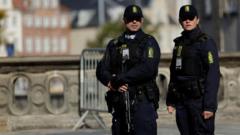
Denmark beefed up security for the summit, banning all civilian drone flights until Friday and placing heavy restrictions on traffic in Copenhagen.
Denmark is also hosting a broader European Political Community summit on Thursday and international allies have lent support to ensure both events pass without incident.
Copenhagen airport, followed by several Danish airports and military sites on the Jutland peninsula, faced drone disruption last week.
Ten allies are providing anti-drone and surveillance support, according to Denmark’s military, which has highlighted an “increased presence of foreign troops and equipment”.
Among the countries contributing are Poland, the UK, the Netherlands, Finland, Sweden and the US. A German frigate has also docked in Copenhagen.
As host to dozens of European leaders over two days, Denmark will want to fend off any more unwelcome surprises in its airspace.
Danish police have not found any evidence that Russia was behind last week’s drone disruption, but Frederiksen linked it explicitly to other hybrid attacks such as Russia’s drone incursion over Poland.
It was part of a pattern that had to be viewed from a European perspective, she told reporters on Wednesday.
“The war in Ukraine is very serious. When I look at Europe today, I think we are in the most difficult and dangerous situation since the end of the Second World War – not the Cold War anymore.”
EPA/Shutterstock
A German frigate has also arrived in the Danish capital to bolster air defences
Sweden has loaned “powerful radar systems” to its neighbour for the week and Ukraine’s Volodymyr Zelensky said Kyiv was sending a mission to Denmark for joint exercises to provide “Ukrainian experience in drone defence”.
German Chancellor Friedrich Merz said ahead of the summit that airspace incursions were getting worse and that it was “reasonable to assume the drones are coming from Russia”.
Drones have been seen in recent days over Germany’s northern state of Schleswig-Holstein, and flights have been delayed in the past week at Vilnius airport in Lithuania and at Oslo airport in Norway because of drone activity.
“We are not at war, but we are no longer at peace either. We must do much more for our own security,” Merz told an event in Düsseldorf this week.
EPA/Shutterstock
European Commission President Ursula von der Leyen raised the idea of a “drone wall” last month
Kremlin spokesman Dmitry Peskov said it was obvious Germany had long been “indirectly involved” in the war in Ukraine and rejected “unfounded accusations” of Russian involvement in last week’s disruption in Denmark.
“Europe would be better off seeking dialogue on security issues rather than looking to build a divisive ‘drone wall’,” he said on Tuesday.
Such is the concern at Russian activity on Europe’s eastern flank that Nato met for consultations twice in September under Article 4 of its treaty, first after drones violated Polish airspace and then when Russian MiG-31 war planes entered Estonian airspace for 12 minutes.
“We have to keep our skies safe,” said Nato Secretary General Mark Rutte, who met Ursula von der Leyen in Brussels on the eve of the Copenhagen summit.
The idea of a drone wall was raised a month ago by von der Leyen, and Rutte said it was “timely and necessary because, in the end, we cannot spend millions of euros or dollars on missiles to take out drones which are only costing a couple of thousand dollars”.
A senior EU diplomat told the BBC that there were still questions over financing the plan and about command and control, but Europe’s response to Russia’s drone violations in Poland had led to some serious soul-searching: “We have to be more agile and find better tools.”
A former brigadier general in the Danish military, Ole Kvaerno, told the BBC that the drone wall was “a political, very generic concept at the moment”, but that last week’s drone activity over his country had been a wake-up call for the authorities and the broader Danish population.
He warned that the target of the next attack might be different.
“It could be infrastructure like energy supply,” said Kvaerno of the Danish Centre for Defence Robotics and Autonomy. “The nature of hybrid war is that it’s intended to take us by surprise. So we’re not done with operational shocks like this one.”
Another flagship project, called Eastern Flank Watch, is aimed at fortifying the EU’s eastern borders by sea, air and land to protect against so-called hybrid warfare, as well as from Russia’s shadow fleet. Von der Leyen said the EU would have to collaborate on this with both Nato and Ukraine.
EU leaders will be shown plans for a “road map” aimed at bolstering defences and developing Europe’s defence industries by the end of the decade to produce state-of-the-art military equipment. The plans will then be worked on with Nato before EU leaders meet again later this month.
According to the plans for being “2030-ready”, Europe needs to move now so its capabilities are prepared for “the battlefields of tomorrow”.
One of the core ideas is to increasingly focus on joint procurement. The EU has already backed proposals to raise up to €150bn (£130bn) on capital markets to help fund defence investment. The UK and Canada are likely to take part in the fund.
The EU’s financial support for Ukraine will also be discussed, more than three and a half years into Russia’s full-scale war.
Ukraine is also a candidate to join the EU, but is facing hardening opposition from Hungary and tensions along their shared border, after Kyiv accused Budapest of sending reconnaissance drones into western Ukraine.
Hungary’s Prime Minister Viktor Orban, who is one of Russia’s closest allies in the EU, claimed Ukraine was “not a sovereign country” as it was being financed by the West.