
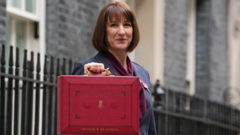

Chancellor Rachel Reeves has acknowledged she is considering tax rises and spending cuts ahead of her autumn Budget on 26 November.
Before the 2024 general election, Labour promised not to increase income tax, National Insurance or VAT for working people.
But the Institute for Fiscal Studies (IFS) says she will “almost certainly” have to raise taxes to make up a £22bn shortfall in the government’s finances.
The chancellor of the exchequer’s Budget statement outlines government plans for raising or cutting taxes. It also includes big decisions about spending on public services such as health, schools and police.
The statement is made to MPs in the House of Commons. It usually starts at about 12:30 UK time – after Prime Minister’s Questions – and lasts for about an hour.
The Leader of the Opposition, Conservative MP Kemi Badenoch, will give an immediate response. MPs will then debate the measures for four days, before voting on them.
There has been a lot of speculation that Reeves will have to raise taxes because she needs more money in order to meet her self-imposed rules for government finances.
She has two main rules, which she describes as “non-negotiable”:
Not to borrow to fund day-to-day public spending by the end of this parliamentTo get government debt falling as a share of national income by the end of this parliamentThe IFS said finding £22bn would allow the government to maintain the £10bn buffer it currently has, but argued there was a “strong case” for trying to increase it further.
The £10bn margin Reeves left herself after her Spring Statement in March was one of the lowest a chancellor has given themselves since 2010, with the average for the period standing at £30bn.
Income Tax and National Insurance
The government could extend the current freeze on income tax thresholds, which is due to end in 2028.
Freezing the thresholds means that, as salaries rise over time, more people reach an income level at which they start paying tax or qualify for higher rates. This is often referred to as a “stealth tax”.
Speaking to the BBC in September, Reeves did not rule out extending the freeze.
The Resolution Foundation think tank – which has close links to some members of the government – says some personal taxes will have to rise.
As part of a package of measures, it recommended cutting 2p from the employee NI rate, while adding the same amount to income tax.
Such a move would potentially affect pensioners, landlords and the self-employed more than workers. This is because their tax would increase but they wouldn’t receive a matched cut to NI.
Reeves says she is looking at tax rises ahead of BudgetHow could National Insurance and income tax change in the Budget?What questions do you have about the Budget?Help with the cost of living
In October, Reeves told the BBC that she would take “targeted action to deal with cost of living challenges” while inflation remains high.
The BBC understands that the government could intervene to bring down gas and electricity bills. This could happen by reducing some regulatory levies currently added to bills, or by cutting the current 5% rate of VAT charged on energy.
The Sunday Times previously reported that it might fall to zero.
Property taxes
Reports suggest the government may reform property taxes. This could include replacing stamp duty – a tax buyers pay on properties above a certain value in England and Northern Ireland – with a property tax.
Landlords could have to pay more taxes, and council tax could be replaced.
Some people selling their main residence may have to pay capital gains tax.
Youth employment guarantee
In September, Reeves said that young people who have been out of work for 18 months will be given paid placements to help them secure full-time employment.
Isa reform
In July, the chancellor ruled out any immediate reform to cash Isas (Individual Savings Accounts). There had been speculation that she wanted to reduce the annual allowance to push people into investing in shares instead.
However, the FT has reported that she may announce a cut in the cash ISA limit from the current £20,000 to £10,000.
Pension changes
There has also been speculation about possible changes to pension rules, such as the level of tax relief available to savers and the size of the cash lump sum which can be withdrawn.
Cutting the higher rate tax relief on pension contributions would save the Treasury money, but may make pension savings less attractive.
Business taxes
The TUC, the umbrella group for trade unions in the UK, has called for higher taxes on online gaming companies and on banks’ profits.
In September, the chancellor told ITV News that “there is a case for gambling firms paying more”.
The Sunday Times reported that William Hill owner Evoke could close up to 200 of the chain’s betting shops in an attempt to stem losses, with the exact number being influenced by any changes to taxes on the sector.
Inheritance tax
In last year’s Budget, the government said that from April 2026, inherited agricultural assets worth more than £1m, which were previously exempt from inheritance tax, would be taxed at a rate of 20%.
In October, the Sunday Times reported that ministers were exploring changes to this, However, Farming Minister Dame Angela Eagle told the BBC’s Farming Today programme there was “no likelihood” of the policy being changed.
The Labour government says that boosting the economy is a key priority.
A growing economy usually means people spend more, extra jobs are created, more tax is paid and workers get better pay rises.
The UK economy has been slowing in recent months after a strong start to 2025.
The latest figures show that the economy grew by 0.1% in August, after a 0.1% contraction in July.
Over the three months to August, UK GDP grew by 0.3%, down from the 0.6% growth seen between March and May.
Meanwhile, government borrowing – the difference between public spending and tax income – reached £18bn in August. That was the highest level seen for the month in five years, driven by higher spending on public services, benefits and debt interest.
Prices are also rising faster than expected. Inflation was 3.8% in the year to August, the same as in July, which is above the Bank of England’s 2% target.
In August, the Bank cut interest rates for the fifth time in a year, taking the cost of borrowing to the lowest level for more than two years.
It made the cut because of concerns that the jobs market was weakening, with data showing job vacancies were continuing to fall and wage growth was slowing.
However, the Bank held rates at its next meeting in September, arguing the UK was “not out of the woods” on inflation.
In October, the International Monetary Fund (IMF) forecast that the UK was set to be the second-fastest-growing major economy in 2025.
However, it also predicted that the UK will face the highest rate of inflation among G7 nations in both 2025 and 2026, driven by rising energy and utility bills.
If approved by MPs, any tax changes in the Budget can come into effect immediately. However, the government must pass a finance bill to make them permanent.
Further details about Budget measures – and what they cost – are published by the Treasury, the government’s economic and finance ministry.
The OBR also publishes its assessment of the health of the UK economy and a forecast of what it thinks will happen in the future.