


Mark Poynting
Climate and environment researcher
Getty Images
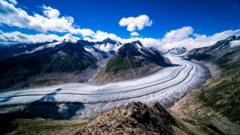
At more than 20km long, Aletsch Glacier is the biggest in the European Alps. But its front has retreated by around 3.2km (2 miles) since 1900, including more than 1km since 2000.
The world’s glaciers are melting faster than ever recorded under the impact of climate change, according to the most comprehensive scientific analysis to date.
Mountain glaciers – frozen rivers of ice – act as a freshwater resource for millions of people worldwide and lock up enough water to raise global sea-levels by 32cm (13in) if they melted entirely.
But since the turn of the century, they have lost more than 6,500 billion tonnes – or 5% – of their ice.
And the pace of melting is increasing. Over the past decade or so, glacier losses were more than a third higher than during the period 2000-2011.
The study combined more than 230 regional estimates from 35 research teams around the world, making scientists even more confident about exactly how fast glaciers are melting, and how they will evolve in the future.
Glaciers are excellent indicators of climate change.
In a stable climate, they remain roughly the same size, gaining about as much ice through snowfall as they lose through melting.
But glaciers have been shrinking pretty much everywhere over the past 20 years as temperatures have risen due to human activities, principally burning fossil fuels.
Between 2000 and 2023, glaciers outside the major ice-sheets of Greenland and Antarctica lost around 270 billion tonnes of ice a year on average.
These numbers aren’t easy to get your head around. So Michael Zemp, director of the World Glacier Monitoring Service and lead author of the study, uses an analogy.
The 270 billion tonnes of ice lost in a single year “corresponds to the [water] consumption of the entire global population in 30 years, assuming 3 litres per person and day”, he told BBC News.
The rate of change in some regions has been particularly extreme. Central Europe, for example, has lost 39% of its glacier ice in little over 20 years.
The novelty of this study, published in the journal Nature, is not so much finding that glaciers are melting faster and faster – we already knew that. Instead, its strength lies in drawing together evidence from across the research community.
There are various ways of estimating how glaciers are changing, from field measurements to different types of satellite data. Each has its own advantages and disadvantages.
Direct measurements on glaciers, for example, give very detailed information, but are only available for a tiny fraction of the more than 200,000 glaciers worldwide.
By systematically combining these different approaches, scientists can be much more certain about what’s going on.
These community estimates “are vital as they give people confidence to make use of their findings”, said Andy Shepherd, head of the Department of Geography and Environment at Northumbria University, who was not an author of the recent study.
“That includes other climate scientists, governments, and industry, plus of course anyone who is concerned about the impacts of global warming.”
Glaciers take time to fully respond to a changing climate – depending on their size, anywhere between a few years and many decades.
That means they will continue to melt in the years ahead.
But, crucially, the amount of ice lost by the end of the century will strongly depend on how much humanity continues to warm the planet by releasing carbon dioxide and other greenhouse gases.
This could be the difference between losing a quarter of the world’s glacier ice, if global climate targets are met, and nearly half if warming continues uncontrolled, the study warns.
“Every tenth of a degree of warming that we can avoid will save some glaciers, and will save us from a lot of damage,” Prof Zemp explained.
These consequences go beyond local changes to landscapes and ecosystems – or “what happens on the glacier doesn’t stay there”, as Prof Zemp puts it.
Hundreds of millions of people worldwide rely to some extent on seasonal meltwater from glaciers, which act like giant reservoirs to help buffer populations from drought. When the glaciers disappear, so does their supply of water.
And there are global consequences too. Even seemingly small increases to global sea-level – from mountain glaciers, the major Greenland and Antarctic ice-sheets, and warmer ocean waters taking up more space – can significantly increase the frequency of coastal flooding.
“Every centimetre of sea-level rise exposes another 2 million people to annual flooding somewhere on our planet,” said Prof Shepherd.
Global sea-levels have already risen by more than 20cm (8in) since 1900, with around half of that coming since the early 1990s, and faster increases are expected in the decades ahead.