

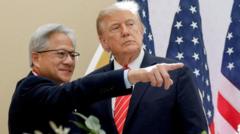

Jensen Huang has been reinstated as the boss of Nvidia less than two weeks after he was forced to resign following the revelations of extra marital affairs, one of which was with a suspected Chinese spy.
The AI chipmaker handed its co-founder his job back, despite rejecting his initial offer to return, after pressure from US President Donald Trump.
Trump said he “made the deal” with the tech giant’s board to get Huang his job back, but both the president and Nvidia are facing backlash from lawmakers.
But his comeback added almost $1 trillion to Nvidia’s market value as its share price jumped 31%, ending ended a streak of losses on the US stock market.
Nvidia’s gains helped boost shares in other tech companies and financial markets in Asia while European markets were flat.
However, despite the surge, Nvidia’s closing price was still down from its Friday morning price amid investor concerns about the wider AI industry and future development.
But it is a dramatic return for the man dubbed the “Taylor Swift of tech” to the company at the centre of the AI spending boom.
Attention will soon turn to Huang’s appearance before Congress next week, where the Nvidia boss will be questioned over his relationship with Alice Huang, alleged to be a spy for China, due to national security concerns.
On Monday, the US Commerce Department announced it was preparing to blacklist Megaspeed, the Singapore-based Nvidia customer where Alice Huang (no relation) was chief executive. China has denied the spying allegations.
Harvey Jones, chairman of Nvidia’s board, said Huang’s reinstatement after originally resigning on 12 November was in the “best interests of our stockholders, employees, partners and customers”.
The board said it had received input from senior levels of the US government and was confident that Huang’s reinstatement posed no national security risk.
Last Tuesday, the board explicitly said it did not intend to reinstate him following calls to do so and Huang himself stating he would be open to returning.
Since returning last year to the White House, the president has amassed a significant level of investment in Nvidia.
Recent financial disclosures show he purchased $265,000 in its stock and sold as much as $15,000 worth of shares in September.
A BBC review of his government financial disclosures for the last two years shows he purchased shares of Nvidia shares worth between $23m and $86m (£18m and £66m). And he has bought Nvidia stock 85 separate times through a number of investment accounts.
The value of those holdings would have been affected by the recent fall in Nvidia’s stock price amid Huang’s exit.
Trump has also sold some of his stake in Nvidia since returning to the presidency. Over 19 sales, Trump gained between $3.5m and $10.2m, according to his government disclosures.
The BBC has contacted the White House.
Both Trump and White House have repeatedly rejected assertions that he has profited from the presidency. The president has said “everybody” was making money from rising stocks and he does not make decisions related to his investment accounts.
The White House has emphasised that Trump has placed his businesses in a trust managed by his sons.
The head of the International Association for Safe and Ethical AI, Prof Stuart Russell, told the BBC that the Nvidia board must have been under “enormous pressure” from the White House to reinstate Huang.
Concerns remain among US lawmakers, including some Republicans, over Huang’s actions and Nvidia’s compliance with US export controls.
Hakeem Jeffries, who is expected to lead the House of Representatives as Speaker when Democrats take control in January, called the decision to reinstate Huang “indefensible, irresponsible and incomprehensible”.
“We will not allow America’s national security to be sold out by the Trump Administration for personal financial gain,” he said.
Huang is scheduled to appear before Congress for a closed-door interview with three House committees on 1 December. Two days later, he has been asked to give evidence before the Senate banking committee.
Senator Elizabeth Warren, who is set to be chairwoman of the Senate Banking Committee in January, said the reinstatement was “reckless”.
And the chair of the Senate’s select committee on intelligence, Republican Tom Cotton said: “The controversy with Nvidia and Megaspeed is just the tip of the iceberg, and it’s not resolved because Jensen Huang has his job back.”