
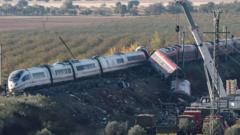

Leaked audio recordings that were published in Spanish media have revealed conversations between train drivers and a control centre just minutes before a deadly crash on Wednesday morning, that has killed 69 people.
Officials are investigating the cause of the disaster, which occurred when a train from Madrid to Seville barrelled into a stationary train.
Three audio recordings between Madrid’s control centre and two train drivers appear to show that one high-speed train was given clearance to move even though another train had stalled on the track, about 25km (15 miles) ahead.
Prime Minister Pedro Sánchez has said that authorities will “get to the bottom of every last detail of this tragedy”.
Dozens of people were injured, with survivors recounting harrowing scenes people crying and bleeding, passengers trapped in their seats, missing limbs and smoke billowing throughout the carriages, one of which caught fire.
On Thursday, Spain’s King Felipe VI and Queen Letizia visited some of the injured passengers in a hospital in Toledo.
He later expressed condolences to the victims’ relatives, pledging that the investigation would determine why the crash happened, and what measures would be taken for this not to happen again.
The crash is one of the worst rail disasters in Europe’s modern history, and Spain’s worst crash since 2013. On Thursday, the country began three days of national mourning.
The moving train, run by state-owned operator Renfe, had 397 passengers on board. The stationary train was run by private operator Iryo, and carrying 147 passengers.
A reported issue with the automatic signalling system – a computer failure – had forced all trains to halt on the affected stretch.
But later the Renfe train was ordered to proceed in “error”, according to Spain’s transport minister.
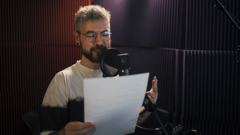
The audio recordings were published by several Spanish news outlets including El Pais and RTVE.
In one, a control centre operator is speaking to the driver of the Renfe train, which was having some technical difficulties.
After some exchanges, the control operator tells the driver: “Continue your journey and then proceed under [Lateral Signalling Block], at normal speed with normal operation.”
The driver replies: “At normal speed?” To which the controller answers: “Yes.”
The Lateral Signalling Block is a back-up or alternative train system used when the automatic signalling or data transmission system fails.
The driver of the stationary Iryo train says in another audio recording that communication with the train-control system has been lost, and it is not moving.
The train “is stationary in front of the entry signal at Urda”, the driver tells the control centre operator. After a series of exchanges, the driver is then told to “resume the journey” normally.
The Iryo driver then contacts the control centre again, according to a later recording, saying they cannot start the train. “The train won’t allow me to control the [security] system. That’s why I am still stopped in front of the entry signal,” they say.
The latter recording suggests that the controller had been notified that the Iryo train remained stationary as the Renfe train approached.
Iryo said its carriages were “struck from behind” by the other train.
Spain’s transport minister Óscar Puente said on Wednesday that the decision to instruct the trains to move again, without any speed restrictions, was “inexplicable”.
The leaking of the audio recordings has been criticised by some Spanish politicians, with Alberto Ibáñez, a member of Congress for the left-wing Sumar platform, writing on X that they were “despicable”.
Irene Montero – the prime ministerial candidate for the left-wing Podemos party – said responsibility for the crash should not be placed on one worker, adding that train drivers and experts have been warning against the liberalisation of the railway sector for years.
From the crash site, Sánchez said: “We are working day and night not only to support the victims’ families, but also to establish every last detail of this tragedy and strengthen safety measures to ensure it never happens again.”
Most Spanish politicians have cancelled all public engagements and suspended their campaigning ahead of a snap election on 29 November.
The exception is the far-right party Vox. Its leader, Santiago Abascal, said his party would not take part in what he described as attempts to “use mourning to silence criticism” of the country’s rail infrastructure.
Overnight, around 1,500 people gathered outside the Spanish transport ministry building in the capital, according to broadcaster TVE, which reported that demonstrators were largely calling for the resignations of Sánchez and Puente.
Police used tear gas to disperse crowds after protesters hurled bottles and flares. No injuries or arrests were reported.
Rail drivers went ahead with a planned strike on Thursday, with the Spanish Union of Railway Drivers (Semaf) saying the strike action was being held “in defence of railway safety”.
The leader of Spain’s main opposition People’s Party Alberto Núñez Feijóo said: “Spain has the right to know what is happening with its infrastructure.”
At the crash site, emergency crews worked through the night under powerful floodlights to cut open metal carriages in the search for victims, with many of those killed in the crash still to be identified.
Hundreds of personnel have been deployed to the disaster site to assist with recovery efforts, Spain’s interior ministry said, with drones and helicopters being used to find victims and remove rubble.
A spokesperson for the Spanish Civil Guard told the BBC they had deployed more than 900 people from different specialist departments, and the priority now was identifying the deceased.
They said they did not know how long this would take, but urged those with missing family members to go to one of the local centres which have been set up to offer DNA samples.