


Indonesia’s Vice-President Gibran Rakabuming Raka tendered his resignation to parliament on Thursday, triggering the process of finding his replacement amid growing turmoil for the government.
Gibran had been facing impeachment calls after a Supreme Court ruling that a high-school document used during his 2024 election campaign was invalid.
His departure comes amid a faltering political alliance between his father, ex-president Joko Widodo, and the incumbent President Prabowo Subianto.
Standing alongside Gibran, Prabowo told reporters he had accepted his resignation with “a heavy heart”. Lawmakers will have 60 days to fill the vacant post, choosing between two candidates named by the president.
“[Gibran] has demonstrated a chivalrous attitude, a strong sense of responsibility, and the qualities of a statesman,” Prabowo said, adding that the resignation was “for the benefit of the nation, the state, and the people of Indonesia”.
“He certainly believes that he completed his education through a proper and structured process. However, we must understand that educational systems abroad differ from those in Indonesia,” the president said.
Gibran has long faced controversy over whether his high school qualifications met legal requirements to run for office.
Having studied in Singapore and Australia, he had used an Indonesian equivalence certificate to demonstrate his educational credentials.
Indonesian law requires vice-presidents to have completed senior secondary school or its equivalent, but the Supreme Court found no evidence to prove Gibran had graduated.
“No evidence was found to show Gibran had a foreign diploma or certificate that could serve as the basis for equivalency with a senior high school or equivalent qualification,” it said.
It also considered a Constitutional Court ruling from earlier in October which came to the same conclusion.
The Supreme Court ruling prompted more than 100 lawmakers to support a parliamentary initiative that could have paved the way for proceedings to impeach Gibran.
Gibran previously argued that undertaking university education was sufficient proof that he had completed senior high school.
On Tuesday, he asked for the chance to challenge the ruling and be given the opportunity to prove the legitimacy of his education credentials, State Secretariat Prasetyo Hadi said.
Gibran’s ascension to Prabowo’s ticket in the 2024 election was part of an alliance formed between his father, outgoing president Joko Widodo – known as Jokowi – and Prabowo, his erstwhile bitter rival.
Gibran was 36 at the time, and only became eligible for candidacy after a controversial ruling by the Constitutional Court, which exempted him from the minimum age requirement of 40.
But tensions between Jokowi and Prabowo appear to have flared.
Since taking the presidency, Prabowo has shown little interest in pushing ahead with Jokowi’s legacy project: the construction of Nusantara, a new capital. Instead, he has focused much of the state’s resources on his own flagship programme to provide free school meals across the country.
In a series of personnel reshuffles over the past year, Prabowo has also shifted many Jokowi loyalists into new roles, including long-serving finance minister Sri Mulyani Indrawati.
Last week, authorities arrested several senior officials, including presidential chief of staff Listyo Sigit Prabowo – no relation to Prabowo – on suspicions of wiretapping the president.
Prabowo sacked Listyo a day later, in what many pointed to as a sign of a crumbling alliance: Listyo, who formerly served as the national police chief, is widely considered a long-time ally of Jokowi.
Within the government, allegiances seem to be shifting. On Monday, three members of Prabowo’s cabinet collectively resigned from the party led by Kaesang Pangarep, Jokowi’s youngest son, citing their desire to focus on their duties in Prabowo’s administration.
But neither man has confirmed the rift. Speaking to reporters on Thursday, Jokowi said he still supported Prabowo’s leadership.
Jokowi also said Gibran’s resignation was part of “political dynamics” and he had told his son “the position was temporary”.
All this is unfolding at a particularly turbulent period in Prabowo’s presidency. The free school meals programme is struggling for funding, parts of Indonesia have recently battled the country’s worst wildfires in a decade, and the national stock market faces crisis amid allegations of widespread market manipulation.
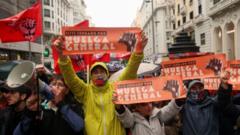
Across the country, students and activists have staged demonstrations to protest against the government’s handling of a range of issues, including the environmental crisis and corruption.