


‘I want to fulfil my dead brother’s dream’ – rebuilding life in Gaza’s ruins
Since the war started the job had become his life. Many of the people being bombed were his neighbours, people he’d grown up with.
Hatem Al-Atar, 25, wasn’t married. His bravery was not reckless, or born of ignorance. He knew he could die any second.
“All days of war since 7 October until now were difficult. Every second in this war was hard. You could lose your life, of a beloved one any second,” Hatem says.
He is sitting in the civil defence office in Deir al-Balah with his comrades. They chat and check their phones. Each one is a survivor.
Ninety-four of their comrades were killed. More than 300 were wounded – nearly half the civil defence organisation in Gaza.
For Hatem, death was as close as the explosion that blew him off his feet in a house near Nasser hospital.
“There were people injured and killed around the house,” he remembers.
“I entered to check if there is anyone there, alive or dead. Once I did, a reconnaissance missile hit the house.”
The footage taken by a colleague shows him striding into the building. A fire is burning to the left of frame.
Then there is a loud blast, clouds of smoke, a man staggering out, but it’s not Hatem.
The moment an explosion rocks the building that Hatem and his colleague (pictured) have just entered
His friends go back inside and drag him out. He’s coughing and has to be held up. But he survives.
Others close to him were not so fortunate.
On 14 March last year – the start of Ramadan – he got a call at four in the morning from one of his brothers.
Nobody in Gaza, in the time of war, called at that time with good news.
“He told me that our house in al-Bureij was hit and my dad was killed.”
Hatem went to al-Aqsa Martyrs Hospital in Deir al-Balah and met a family friend who directed him to the mortuary.
“When I went there, my father was laid on the floor next to eight other bodies. They were my sister-in-law and her seven children! I was in shock.”
Still, Hatem kept going, into the place of explosions, collapsing buildings, the rubble where the dead and occasionally the living were buried. He pulled out bodies, and parts of bodies.
Then came the hour when the bombing and shooting stopped.
The first night without air strikes. The time to start thinking of something that had not been guaranteed over the last 15 months – a future.
His thoughts turn to education, and romance.
“With the deal, I should think what to do next. I will pursue my university study once universities are back in business. I’m single but I will think about getting married.”
EPA
Palestinians have been starting to return to Rafah in the hours following the start of a ceasefire
To try to tell the story of how the people of Gaza experienced this war, I and BBC colleagues have depended on the tireless efforts of local journalists working on our behalf.
Israel banned the foreign media from entering Gaza to report the war independently.
The BBC’s local journalists have been on the streets almost non-stop for the last 24 hours capturing the mood of Gaza in the time of ceasefire: a gunman standing in the roadway in Nuseirat in central Gaza, firing into the air; Hamas fighters and police re-emerging; a few yards down the road another group of men shooting towards the sky; crowds gathering at cross streets and on corners; a man kneeling and kissing the ground.
This was the scene in Gaza City’s main square just before the transfer of three Israeli hostages as part of a long-awaited ceasefire agreement between Israel and Hamas
But all of this is taking place against a backdrop of ruin. Trucks and cars trundle past, weighed down with people’s belongings. Some use donkey carts to haul what possessions have survived after their multiple displacements.
There are hundreds of thousands of journeys in Gaza today. Some are actually under way. Others exist in the imagination. All have one direction – home.
Prof Jumaa Abu Shiha arrives at what remains of his house in Nuseirat.
First, he says the feeling of having survived is “indescribable”. He prays to himself: “God is the best disposer of our affairs.”
He repeats this as he goes from one ruined room to another. His wife and several children follow.
Walls are blown out. The interiors are scarred with machine gun and shrapnel marks.
The moment Prof Abu Shiha found his house in ruins
Prof Abu Shiha describes how he built the house “block by block”, painted it and cherished the moment he brought his family to live here.
“I can’t find a house, I can only see destruction not a house,” he says. “I didn’t expect this. I was expecting to come back to a house and find a place to shelter me and my children.”
He points to his daughters’ room, and his sons’ room, so carefully decorated and now laid waste. “The feeling is indescribable,” he says.
There is a massive task of rebuilding ahead. The UN and aid agencies have repeatedly accused Israel of obstructing the flow of aid; the United States at one point threatened to curb military assistance to Israel unless more aid was allowed into Gaza. Israel denies restricting aid.
Aid trucks were crossing into the strip throughout the afternoon. Among them was a convoy from the Jordan Hashemite Charity Organization, which we reported on last week, on the journey from Amman towards Gaza.
Forklift trucks moved tonnes of medicine and food to help the nearly two million displaced in Gaza – roughly 90% of the population.
Getty Images
Such aid is tangible assistance. It can be weighed, counted, loaded, and ultimately distributed. People can be fed and given medicine. But there is another challenge whose demands are immense, and which will have a profound impact on the future of Gaza.
The war has created unknown numbers of traumatised adults and children. We have recorded some of their stories but are aware of the tens of thousands more that remain untold.
Children have faced acute suffering. According to a survey of the caregivers of 504 children, for the UK charity War Child, 96% of children felt death was imminent.
The interviews also found that 49% had a desire to die. Frequently our journalists have heard young survivors say they wished they could join a dead mother, father, or sibling.
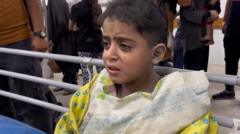
Ten-year-old Amr al Hindi was the sole survivor of an Israeli strike on the building where he lived in Beit Lahia last October. Our colleague in the area filmed Amr in hospital just after the attack.
The floor around him was covered with the wounded. A woman sat with blood seeping from her ear. Nearby a man had just died.
“Where’s Sherif?” Amr asked repeatedly. A nurse told him Sherif was OK. “I will take you upstairs to see him.” But Sherif, his brother, did not survive. Nor did his other brother, Ali, or his sister Aseel, or his mother and father. The whole family was gone.
Just after the ceasefire agreement was announced we went back to see what had become of Amr al Hindi. He was living with his grandparents, and it was clear they loved him with care and tenderness. The child had three of his toes amputated after the bombing, but was managing to walk normally.
Amr sat on his grandfather’s lap and stared directly at the camera. He was still, and composed, as if he was looking out from behind a thick protective screen. He began to speak about his brother Ali and how he had wanted to go to Jordan and study to become a doctor.
“I wish to become like Ali. I want to fulfil his dream, and travel to Jordan to become a doctor,” he said. But over the last few words tears began to fall and he broke into sobs.
Amr’s grandfather kissed him on the cheek; he said “darling” and patted his chest.
In this moment it is understood that there are many wars here.
Some that have paused. Others that, for the survivors, will live long into the future.
With additional reporting by Alice Doyard, Malaak Hasona and Adam Campbell.