


Fatbergs, feathers and flocks of sheep – inside the new London Museum
Image source, Reuters
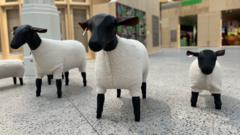
Image caption, The museum’s Our Time space will host events among 13 large installations and flocks of sheep benches
ByTim Stokes
Reporting fromat Smithfield Market
Ten years ago the Museum of London announced it would be leaving its former home to move to the abandoned halls of Smithfield Market. Now rebranded London Museum, it is set to open its doors to the public on Saturday after a £437m project. So what’s it like inside?
Leaning back on a leather sofa, museum director Sharon Ament looks across a vast brick-lined space that once bustled with market traders but is now filling with its newest visitors.
“I really love this space, it just makes me smile every time I come in – it’s actually joyful,” she says.
The vast room, now known as Our Time, is dotted with installations reflecting living memory.
In one corner a life-size mechanical giraffe flicks its ears in front of a lit-up NHS sign representing lockdown. Another wall has remnants of London’s former greyhound tracks. Near it is the old switchboard from Buckingham Palace.
And beneath the magnificent domed ceiling roam several flocks of large plastic sheep which Ament encourages people to “pull up and take a seat” on.
“There are grins on people’s faces, so I think we’ve pulled something rather incredible off,” she says.
Image source, Reuters
Image caption, Sharon Ament says she wants the museum to be a shared space for everyone
Image caption, The museum reflects London’s more recent history such as its greyhound-racing tracks – the fireplaces of the market traders’ former offices can be seen behind
A visit to the new museum starts before this point as people enter through a large covered street known as Real Time.
Here, data-filled digital displays tell of London in the moment, beside a Banksy-graffitied sentry box and the last bell to be cast at the historic Whitechapel Bell Foundry.
Next they enter the former General Market with its sheep, giraffe and signage.
This is the space where events like late-night house parties and dinner clubs will be held beside shops and eateries, including former Victorian cocoa rooms that will be open 24 hours a day at weekends.
Such hints of the building’s past are everywhere. Halfway up the walls are the restored fireplaces of the traders’ former offices, along with twisting metal staircases that once led up to them.
“Whenever we’ve found historic fabric, we’ve restored it or kept it, and we want to show the layers of history,” explains Alec Shaw, who has led the entire project.
“We wanted a museum that worked like the market, that allowed you to come in any corner and just walk across, walk through the building on your way to work, or, hopefully, stay a bit longer.”
Image source, Getty Images
Image caption, Smithfield’s General Market opened in the 1880s and was in use until the 1990s
Image caption, The Our Time space seen in early 2024 when water was still splashing into the building
Shaw previously showed me around the site nearly three years ago, when scaffolding and supports were holding up the walls and there were constant splashes of water dripping on to the floor.
Restoring a Victorian relic that was abandoned in the 1990s “really tested all of us”, he admits, and that was before the logistics involved in designing a new museum from the venue’s seven-million object collection.
Five thousand of these are now on site and another 300,000 are due to arrive for when the former Poultry Market becomes a museum space in 2028.
“We think you could take at least eight hours to see every object downstairs, and that means you’re going to keep coming back.
“The best museums are those that you go, ‘Right I’ll do that one today. I’ll do this gallery next time,'” he says.
Image caption, Our Past is based in the building’s basement and tells a weaving story of London through five different chapters
Image source, Reuters
Image caption, Queen Victoria’s mourning dress is among the objects on display
A wide staircase to one side descends into what is called Past Time.
Down here is what once was street level of Roman London, and curator Annette Day explains that “we felt that right in the guts, in the earth of the city, that was the place where we should explore London”.
A weaving route beneath a seven-metre-high brick vaulted ceiling tells the capital’s story.
It starts with the city’s creation by the Romans and moves through medieval times and London’s place as the centre of the British Empire, before ending with the 2012 Olympic Games, a time when “London looked at itself and the world looked at London”, says Day.
Along the way are all manner of objects.
There’s Charles I’s execution vest, Queen Victoria’s mourning dress, a white 1960s Ford Cortina, an overstuffed taxidermy cat called Oliver and the shimmering Elizabethan jewellery of the Cheapside Hoard.
Image caption, Large illustrations are incorporated with historic objects to tell the story of the Great Fire of London
Image source, EPA
Image caption, Oliver the overstuffed taxidermy cat was once a Londoner’s pet
Galleries on either side also focus on specific moments.
One features a recreated Roman room with amphoras – two-handled jars – a mosaic floor and the pieces of a magnificent wall painting found in Lime Street 20 years ago that hang on the wall.
Another uses large comic illustrations based on new research to tell the story of the Great Fire of London in an attempt to reflect the subject’s inclusion in Key Stage 1 of the national curriculum.
Further along still, two other archways branch off to look at the lives of Londoners and the city’s landscape, placing objects from across the ages alongside each other.
The delicately feathered Dying Swan outfit worn by lauded Russian dancer Anna Pavlova stands beside the stage outfit of Edwardian music hall star Kitty Lord in one case, while another shows 2,000 years of London-made shoes.
One case is even filled with toilets and chamber pots from medieval times to today.
And to carry on that subject, on the far wall a small porthole frames a chunk of the eponymous Whitechapel fatberg, not far from the huge glass window that looks out on passing Thameslink trains (whose passengers apparently are yet to notice they are now being watched).
Image source, Reuters
Image caption, Visitors can while away the hours watching Thameslink trains pass by the galleries
Image caption, The museum has a small chunk of the Whitechapel fatberg, which weighed 130 tonnes and stretched more than 250m along a sewer
Even with its planned events, shops and eateries, Ament says it is all these objects which remain “the essence of the museum” because they “tell stories in a compelling way”.
She sees the museum as a shared space for everyone, somewhere for Londoners and tourists alike to connect with people and stories from the past and now.
“Think of this as like one of my favourite buses, the number 63 bus. You meet the world on it. And you meet the world in here.”
Most important of all, she says, is that the London Museum must always represent and reflect the city it is in.
“The story of London is tough and joyful at the same time. That’s why we use ‘grit and glitter’ as a tagline – it’s both of those things, those dualities can exist. And we shouldn’t be frightened of that history,” she says.
“We are making a museum and it will never stop, just like London never stops. There’s always cranes in London and there’ll always be new things in London Museum.”
Image caption, Visitors to Our Time are watched over by a life-sized giraffe model that flicks its ears
Related topics
More on this storyRelated internet links