

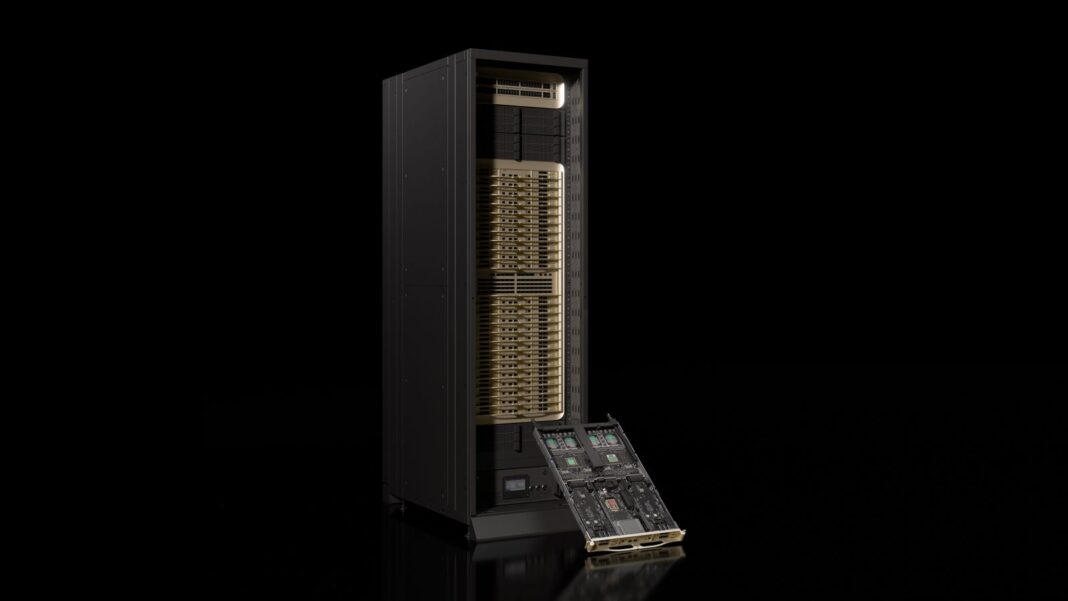


- Nvidia’s new Rubin HPC contains more than 50,000 CUDA cores
- Its core count exceeds the RTX 5090’s 21,760 by over 28,240
- Nvidia expects Rubin HPC to reach deployed systems sometime in 2028
Nvidia has unveiled a new processor for scientific computing, with more than 50,000 CUDA cores contained within one graphics processing unit.
The Rubin HPC accelerator is intended for demanding simulations and data analysis, rather than consumer gaming or conventional desktop graphics applications.
Its core count exceeds the GeForce RTX 5090’s 21,760 CUDA cores by almost three times.
Over 50,000 CUDA cores with availability scheduled for 2028
Announced at the SC26 supercomputing conference, Rubin HPC will join Nvidia’s Vera Rubin platform as a specialized accelerator for technical workloads.
Nvidia says the chip will help researchers run simulations examining materials, molecules, industrial designs, climate systems, and other complex scientific processes.
The company expects the GPU to become available in 2028, leaving organizations several years before they can evaluate its performance in deployed systems.
The chip design combines numerous processing cores with faster data movement between computing components.
Nvidia says this balance should prevent processing units from remaining idle while waiting for information, a problem affecting data-intensive scientific calculations.
Rubin HPC also incorporates sparse data acceleration, intended to improve operations that retrieve limited information from much larger datasets during calculations.
According to the company’s technical description, these operations occur in applications involving sparse matrices, stencil calculations, sorting, and reduction tasks.
Such calculations recur across simulation, analytics, and engineering software, where the time required to access information can influence completion speeds.
The accelerator also adopts seventh-generation Nvidia NVLink technology, which is designed to improve communication between GPUs operating together inside larger computing systems.
That connectivity matters when complex simulations are distributed across multiple processors, although Nvidia has not published throughput figures for this implementation.
Scientific simulations and AI drive the new GPU’s development
Nvidia links the hardware to growing use of AI agents in scientific and engineering research, where software can propose possible candidates.
Researchers can use simulations to assess proposed materials, molecules, and designs before committing resources to laboratory experiments or physical prototypes.
Faster calculations could allow teams to examine more possibilities, although actual improvements will depend on software, system configuration, and measured performance.
“For agents tackling science and engineering, faster simulation means faster discovery,” said Ian Buck, vice president of hyperscale and high-performance computing at NVIDIA.
“Rubin HPC accelerates the simulations agents use to test ideas and guide their next steps, helping scientists and engineers explore more possibilities and bring breakthroughs closer.”
Nvidia also cites its CUDA-X libraries, which provide optimized software implementations for algorithms used in simulation, scientific research, and data analysis.
The company says these tools can operate alongside Rubin HPC to accelerate calculations initiated by AI agents and other scientific applications.
However, independent testing has not established how much faster specific workloads will run, leaving the practical performance claims awaiting verification.

Follow TechRadar on Google News and add us as a preferred source to get our expert news, reviews, and opinion in your feeds.