
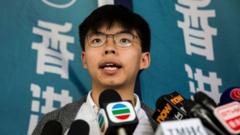

Wong, who turned 30 last month, has already been imprisoned multiple times for his activism which started when he was in his early teens.
On Thursday, he arrived in court wearing a dark blue long-sleeved shirt, khaki trousers and black-rimmed glasses. He looked slimmer compared to his previous public appearances.
He nodded in greeting towards members of the packed public gallery, and took notes intermittently as the judge read out the reasons for his sentencing.
A crowd had gathered outside the court, with dozens of Hongkongers having queued for hours hoping to get a seat in the public gallery. There was also a heavy police presence.
Wong is already serving time for subversion and was due to be freed early next year when he was handed the latest charges, to which he pleaded guilty in September.
Two months and two days of the 10-year term will be served concurrently with his ongoing sentence, the judge said on Thursday.
Prosecutors said Wong had conspired with other campaigners, including self-exiled activist Nathan Law, to lobby for foreign sanctions and blockades against Beijing.
These activities took place between July and late November 2020, the court heard.
Wong and Law had been co-founders of Demosisto, a now defunct pro-democracy political party.
On Thursday, Hong Kong’s chief executive John Lee said Wong and Law were “among the primary culprits responsible for undermining Hong Kong’s prosperity and stability”.
Their actions “not only severely undermined national sovereignty, security, and development interests, but also directly prejudiced the well-being of the general public and the stability of society,” Lee said in a statement issued after the ruling.
Beijing’s foreign ministry said China “firmly supports [Hong Kong] in safeguarding national security in accordance with the law”. It also called on “relevant parties” to “earnestly respect China’s sovereignty and Hong Kong’s legal system”.
Wong’s friend and fellow activist Frances Hui, now based in the US, said she was “heartbroken” and “outraged” by the verdict.
“Today’s sentencing is not just about Joshua. It is part of a broader political crackdown that seeks to rewrite a chapter of Hong Kong’s history and erase the contributions of an entire generation who believed they could shape the future of their city,” she told the BBC.
The UK said the sentencing was “a clear example of how the National Security Law is being used to target individuals for political expression and participation”. In a statement shared with the BBC, a UK government spokesperson called for “an immediate end to all unjust prosecutions” of individuals charged under the NSL.
According to the US consulate in Hong Kong, the sentencing showed Beijing “will go to extraordinary lengths to silence those who advocate for fundamental freedoms” in the Chinese territory.
Human Rights Watch described the sentence as “cruel and unjust”.
“To keep Hong Kong society subdued, and to reduce the chance of an international outcry, the Hong Kong government appears to have adopted the tactic of stacking charges against influential pro-democracy leaders,” said its Asia director Elaine Pearson.
The harshest sentence under the controversial national security law (NSL) thus far has been handed to 78-year-old former media tycoon Jimmy Lai, who was jailed for 20 years, also after having been found guilty of colluding with foreign forces.
By 2014, Wong, who was then at the forefront of a civil disobedience movement known as the “Umbrella Movement”, had already become one of the most recognisable faces among Hong Kong’s pro-democracy activists.
In 2016, he co-founded Demosisto with Nathan Law and Agnes Chow, activists who are now based overseas.
But he often expressed discomfort at being labelled a “protest leader”.
“We have a lot of facilitators in this movement and I’m one of them… Instead of having a top-down command, we now have a bottom-up command hub,” Wong told The Financial Times in November 2019.
Demosisto disbanded in 2020, the year Beijing introduced the NSL in Hong Kong.
Law left for the UK and continued his advocacy abroad, while Wong stayed on in Hong Kong and tried to run for a seat in its legislature – but was barred, with authorities citing his opposition to the NSL as one of the reasons.
Meanwhile, the court cases against Wong were stacking up.
On 23 November 2020, he pleaded guilty to several charges related to his involvement in protests outside the Hong Kong police headquarters in 2019.
Then came the NSL charges. While still in prison in February 2021, Wong was among 47 people charged with “conspiracy to commit subversion”. The group became known as the Hong Kong 47 and remains the largest prosecution so far under the NSL.
Wong was still serving his 56-month sentence for the subversion conviction when he was charged with collusion under the NSL last year.
On 22 November 2020, the day before he pleaded guilty to the protest charges, Wong wrote in a post on Instagram addressed to “the people of Hong Kong”: “To be honest, I have never had much faith in Hong Kong’s politics, but I have every confidence in the people of Hong Kong.
“Even as political power now poses a comprehensive challenge to the resilience of our civil society, I believe the people of Hong Kong will, as always, find a way to see things through.”
Additional reporting by Martin Yip