

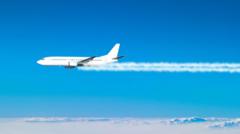

We’ve all looked up and seen the white lines trailing behind aircraft in the sky.
Known as contrails, these icy clouds contribute to climate change, and scientists have been trying to work out how to stop them.
Now, a £5m UK trial will test whether AI can help, by predicting where warming contrails are likely to form and getting planes to avoid those areas.
It will focus on the Shanwick Oceanic airspace in the eastern half of the North Atlantic corridor which accounts for approximately 5% of global contrail warming.
The 30-month Operation Blue Skies project brings together Google, the UK government, the Met Office, air traffic control provider National Air Traffic Services (NATS) and researchers at the University of Cambridge and Imperial College London.
Contrails – also known as vapour trails – are made when the hot exhaust from aircraft engines meets the cold air at high altitude, creating ice crystals.
Many disappear quickly, but in particularly cold and humid conditions they can persist and spread, forming clouds which trap heat that would otherwise escape from the Earth.
Dr Paul Hodgson, Google’s technical lead for the operation, told the BBC’s Tech Life programme his five-year-old has a more colourful description for the white lines – “sky graffiti”.
“We think that contrail warming is responsible for something like a third of all aviation climate warming,” he said.
Dr Hodgson acknowledged there was uncertainty around the precise figure, but said scientists were confident it was “either quite a large problem or a very large problem”.
The project also comes as the government backs expansion of UK airports, raising the wider question of whether tech solutions can sufficiently reduce aviation’s environmental impact as demand for flying grows.
Google is also one of many big tech companies spending billions on new data centres – the giant, power-hungry banks of computer chips which power AI – which environmentalists are concerned will contribute even more to climate change.
The idea behind the trial is that if scientists can predict the areas of the atmosphere where contrails are likely to form, aircraft could avoid them.
Google will use satellite images and flight data to identify where planes have previously produced contrails.
This is then combined with weather patterns to forecast where the conditions for new contrails are likely to occur.
The information will be passed to NATS, where air traffic controllers can direct pilots to avoid those areas.
Rather than dramatically changing the route of a flight, the trial will mostly involve changing an aircraft’s altitude by around 2,000ft.
This is something which already happens routinely to avoid turbulence and bad weather so passengers are unlikely to notice.
Ian Jopson, director of sustainability at NATS, said it should be “pretty much business as usual using existing procedures for the operators on the North Atlantic”.
Testing will take place during selected evenings and nights in the winters of 2026-27 and 2027-28, when air traffic is lower.
Around 10,000 flights are expected to pass through the airspace during the trial periods, although only a fraction will need to change altitude specifically to avoid contrails.
The Department for Transport is providing £2.65m towards the programme, while Google is contributing £1.4m through AI research, engineering and computing infrastructure.
Aviation Minister Keir Mather said the project would test “small tweaks to flight paths over the Atlantic” which could help make flying cleaner.
“This is a world-first, and it’s British ingenuity leading the way,” he said.
Changing the altitude of an aircraft can mean it burns more fuel, raising an obvious question – could avoiding contrails simply create additional carbon emissions elsewhere?
Hodgson said previous trials suggested the additional fuel use was much smaller than the climate benefit of preventing a warming contrail.
“The CO2 penalty is in the order of less than 1%, compared to the contrail cost, which is of a similar order magnitude to all of the CO2 of aviation,” he said.
Modelling for Operation Blue Skies suggests a full deviation through Shanwick would mean around 100kg of additional fuel per affected aircraft.
Previous airline-level trials have achieved reductions of around 60-70% in contrail formation or warming, according to Hodgson.
The results of Operation Blue Skies are expected to be published in academic literature and opened to wider scientific scrutiny.