

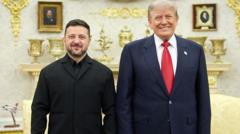

While there was no official US confirmation of military assistance to Ukraine, Zelensky said afterwards that Trump had agreed to give Ukraine licences for domestic production of Patriot missiles.
“He accepted that he will give us licences,” Ukraine’s leader told Fox News, “and then I had a meeting with representatives of production, very strong military companies of the United States.
“I hope that we will do co-production.” The BBC asked the White House for comment.
Zelensky also met a bipartisan group of US lawmakers just before the Senate voted overwhelmingly to sanction buyers of Russian oil and gas.
The Ukrainian president told reporters beforehand that such sanctions are a “big signal to Europe, big signal to Ukraine, big support of our people”.
The Patriot is one of the few air defence systems able to intercept ballistic missiles, which Russia has increasingly used to bombard Ukrainian cities.
It can catch rockets with flight ranges of up to 1,000km (620 miles). One battery can simultaneously track up to eight targets and detect more than 100.
But it comes with a price tag – each missile for the Patriot is estimated to cost from $3m to $5m.
Zelensky and the Ukrainian army have previously said Ukraine needs 25 Patriot interceptor systems.
As well as beefing up Ukraine’s military, domestic production of Patriots would shore up Zelensky’s approval rating in the wake of recent protests over his decision to oust a popular defence minister.
The key question is where Ukraine might produce those systems away from the prying eyes of the Kremlin, and whether it could be done quickly enough to alter the balance of the conflict.
Shortly after Zelensky left on Tuesday, Netanyahu arrived at the White House for talks that were expected to focus heavily on the conflict in Iran.
Once-friendly ties between them have become more tense in recent months, with Trump frequently criticising Israel for continuing strikes in Lebanon and ignoring a ceasefire.
Afterwards, Trump said in a brief post on Truth Social that it was “a very good meeting!”
Netanyahu told Israeli media the two had “an understanding of a shared goal, to ensure that Iran does not have nuclear weapons, and other goals as well”.
“One of the best conversations I have had with the president of the United States,” he added.
A photograph of the two leaders shared on Netanyahu’s X account shows the two men seated in the Oval Office, smiling towards the camera.
After the meeting, the US military said Iranian forces had attempted a surprise attack on American forces in the Middle East, but that all the missiles were intercepted.
US and Saudi forces meanwhile attacked Iranian proxies in eastern Iraq which had allegedly fired drones at Saudi energy infrastructure, according to the US military. Tehran has not yet commented.