

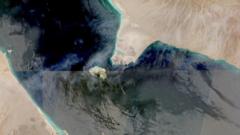

Yemen’s Houthis say they have attacked two Saudi oil tankers in the Red Sea as the US launched its 12th consecutive night of strikes on Iran.
Iranian state media said two people had been killed in the US strikes on Wednesday, and a tanker caught fire in an explosion in a mined route in the Strait of Hormuz.
Ahead of the latest round of strikes, US President Donald Trump had threatened to destroy an Iranian bridge or power plant if Iran attacked a ship in the strait and to “take care of” the Houthis if they blocked the Red Sea.
If confirmed, the Houthi attack would be the first since the Iran-backed group announced a “maritime embargo” against Saudi Arabia.
The Houthis named the tankers as the Encelia and the Layla, though their responsibility has not been confirmed.
The group’s military spokesperson Yahya Saree said they had targeted the ships with drones and missiles for allegedly violating its naval blockade.
Saree added that the Houthis promised to continue their naval operations and would continue “enforcing the ‘siege for a siege’ equation”.
The state-run Saudi Press Agency confirmed early on Thursday that the Encelia was struck “while sailing in the Red Sea”, resulting in a fire on its bow.
Citing an unnamed official source at the Transport General Authority, it described the attack as a violation of international law. All crew were safe, it reported.
UK Maritime Trade Operation (UKMTO) reported an “unknown projectile” struck a Saudi tanker about 130km from Al Shuqaiq in Saudi Arabia at 20:00 GMT. The attack caused a fire but no casualties, it said.
British maritime risk management group Vanguard also reported that the Saudi tanker Encelia had been hit.
The attack on the Layla has not been confirmed.
US Central Command (Centcom) said at 21:30 GMT it had launched strikes at Trump’s direction “to further degrade Iran’s ability to threaten civilian mariners and commercial vessels transiting regional waters”.
The strikes targeted “Iranian military targets including maritime capabilities, missile and drone storage facilities, coastal surveillance sites, and air defense assets,” it said.
Kuwait, Jordan and Bahrain soon reported responding to airborne threats, before Iran’s military said they had targeted US assets in all three countries, according to AFP.
Iranian state media reported two people had been killed in US strikes on the country’s south near its border with Iraq.
Meanwhile, the Iranian Revolutionary Guard (IRGC) said the Strait of Hormuz was “completely closed” after an explosion in the channel, Iranian state media reported.
The IRGC said it had stopped three oil tankers from passing through the strait.
One tanker caught fire and two others turned back after attempting to pass through a mined route south of the strait, according to Iranian state media.
It comes after Trump promised earlier on Wednesday to attack an Iranian bridge or power plant if its forces hit ships in the Strait of Hormuz.
Iran’s Foreign Minister Abbas Araghchi later warned of an “eye for an eye” response to attacks on Iran.
On Tuesday, Trump told reporters he would “take care of the Houthis” should they obstruct the Red Sea as they had said.
Few details of the “maritime embargo” were given by the Houthis when it was announced on Monday, but a media official said they were closing the Bab al-Mandab Strait – the Red Sea’s southern gateway – to Saudi vessels.
The Red Sea has become crucial for oil shipments from Saudi Arabia during the US-Israeli war with Iran, which has led to the effective closure of the Strait of Hormuz in the Gulf.
Now, the threat from the Houthis risks further disruption to international shipping, with hostilities in the region having already led to global fuel prices fluctuating significantly.
So far, at least seven oil tankers have made U-turns close to Yemen since the embargo. Saree claimed the Houthis had “forced approximately ten ships to retreat and return”.
The disruption in the Red Sea comes as peace negotiations have effectively stalled between the US and Iran.
Both countries signed a Memorandum of Understanding (MoU) in June to halt military operations and reopen the Strait of Hormuz, as well as to reach an agreement to end the war over the following 60 days.
But three weeks after it was signed, Trump declared the ceasefire “over” after Iranian attacks on ships in Hormuz, and US strikes in response.