

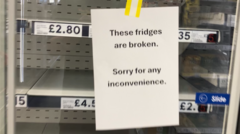

David Morris, who was shopping in Cheddar, said the situation was worrying.
“It reiterates the fact we’re entirely unprepared for this climate situation.”
He said people need to “pull together” to help resolve issues for the next generation.
Another shopper said a local express store had “hiked up prices yet they can’t keep the fridges going”.
But surely, I wonder, don’t they have fridges in hot countries that cope just fine?
“It’s just down to money,” Dr Foster smiled.
Supermarkets are already designing fridges for 35C, even 38C, he said.
But to replace all the older supermarket fridges overnight is “impossible”, he warned.
“It’s very expensive, there are lots of systems out there, they’ve got a life of 20 years and they can’t just replace them all now, because the investment is too expensive.”
The problem isn’t limited to supermarkets. Engineers repairing domestic appliances said demand has surged during hot weather.
“The phones were ringing off the hook,” said Cindy Nellis, from Bath Domestic Appliances.
“High temperatures in the fridges, compressors being ever so noisy, or completely packing up altogether.”
For Nellis and her colleagues at their base in Westbury, Wiltshire, the problem is simple- old fridges can’t take the heat.
“The older ones are set between 18 and 25C,” she explained. “Compared to the new ones, which work at 35C.
“So therefore when you hit 35, which we’ve been having, the compressor goes into overdrive. They really just give up the ghost, poor things!”
The food industry has recognised that heatwaves are causing it a problem.
Rupert Ashby, from the British Frozen Food Federation, said freezers are breaking down or being switched off in supermarkets in the extreme heat because the systems find it hard to deal with the high temperatures.
“The way the fridges work is to cool everything down and expel the hot air,” which normally works well in the ambient air in the UK.
“[However,] with heat like this, trying to expel that air is very difficult,” he added.
He said older stores tend to have a remote compressor on refrigeration units with the condensers outside. Because the system is on the outside, it is finding it hard to expel that hot air.
A spokesperson for Tesco said: “There were a few isolated issues affecting our refrigeration units in stores; however, these were not indicative of any broader issue across our estate.”
They said they had maintenance teams working hard to resolve any isolated issues “as quickly as possible… with customers still able to access fresh and frozen products across the vast majority of our stores”.
Next week, the Met Office is predicting another hot spell, with temperatures in the “low to mid 30s” across much of the UK.
Back at his research lab, Dr Foster’s team is working with many of the supermarkets to redesign fridges for a warmer world. But, he warned, there is no magic wand.
“It could take 20 years before all the refrigeration systems out there are at the maximum temperature they are being designed for today. And by then that will be too low.”