

As the country’s economy recovers from the slowdown triggered by US tariffs, the Organisation of Economic Co-operation and Development (OECD), an influential global policy group, projects a modest improvement in gross domestic product (GDP) – growth of 1.7% – in 2027.
Earlier this month, data from the country’s statistics agency said Canada had slipped into a technical recession – two consecutive quarters of GDP decline, in late 2025 and early 2026.
“The government is responding in real time to shifting global economic volatility and broad-based supply chain disruption with a serious plan to grow exports, create jobs and invest in productivity forward projects,” said John Fragos, a spokesman for Finance Minister François-Philippe Champagne.
Economists cautioned against panic, saying the country is likely to avoid a prolonged downturn especially given the small decline.
“Whether one chooses to divine the fact that we’re in a recession or not really does miss the point,” said Jeremy Kronick, president of the CD Howe Institute, a non-partisan economic think tank.
“I mean, it, the economy, is weak, right?”
“That process is settling in during that time as the major investments, major changes to how the government operates, how we do major projects, how we have new trade agreements with other countries.”
His Liberal government has plans to, among other actions, double Canada’s non-US exports over the next decade by expanding trade relationships across Europe and Asia, and to fast track major infrastructure projects.
Dave McKay, CEO of the Royal Bank of Canada, the country’s largest bank, cautioned during a talk hosted by Bloomberg earlier this month that the clock is ticking.
“We have to see tangible progress on a couple of these big ideas,” he said. “The capital is impatient, and it will move where it thinks they can get the most sure and fastest return.”
Kronick, of the CD Howe Institute, said uncertainty with Canada’s largest trading partner, the US, is another headwind.
For James White, the US-Canada trade war has had a major impact on his family-owned company, Wellmaster.
The Ontario-based firm manufactures products for drillers, and White, the firm’s president and CEO, said 60% of its profitability is reliant on access to the US market.
But since the tit-for-tat tariffs began last year between the two trading partners, sales are down by 20%. His business has been affected by US levies on steel derivatives – and Canada’s similar retaliatory tariffs.
“I’m being pulled down in my ability to make investments in my people and my technology and my equipment. That’s not happening with my competitors,” he said.
US tariffs hit Canada slightly differently compared with other nations, as the country shares a border with the largest economy in the world. More than 70% of Canadian exports head to the US, and the economies are deeply integrated.
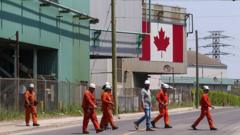
While the majority of products are exempt from US tariffs under the current free trade agreement between the US, Canada and Mexico – the USMCA – the White House has imposed tariffs on specific sectors, including 15% to 50% tariffs on steel, aluminum, and copper – the ones proving challenging to White – and 25% tariffs on vehicles.
“What’s key is just that there are these different parts of the economy or the country that are affected differently,” said Kronick from the economic think tank.
“We’ve seen big changes in [auto hubs] Brampton and Windsor and changes where steel, aluminum, and autos are all impacted. I think they’re experiencing it far more acutely than, perhaps, people in downtown Toronto.”
Ottawa is negotiating with the US both to reduce these sectoral tariffs and on a review of the USMCA but have yet to reach a deal. Businesses in Canada just want certainty.
So, how is Canada positioned for the future?
Kronick said Canada’s economy has some structural issues feeding the stagnation, such as trade barriers between provinces – things like different trucking requirements, or professional licensing – and a tax system he calls “uncompetitive”.
But there are some fundamental strengths too.
“If you were drawing up a country from scratch, a well-educated, well-resourced, not overpopulated country would be what you would want, right? So, I think Canada has all those things, all those features,” he said.
“I think we just have to unlock them.”
With additional reporting by Nadine Yousif