

BBC
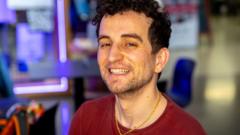
René says he is now happy to be photographed “because the republic of fear is gone”
It belonged to his grandmother. Something solid. A thing to hold in his hands, and run his fingers across, and trace the path of memory. A small thing of beauty, inlaid with a delicate mosaic.
René opens the music box, and a tinkling music begins to play, the same song heard long ago in his Damascus sitting room.
“This is all I have left of my home,” he says.
Everything about this young man suggests gentleness. René Shevan is short in height, slender and speaks softly.
All week his emotions have gone back and forth. Joy at the fall of Bashar al-Assad. Heartbreak at the memories it has triggered of his months in Syrian prisons.
“There was a woman. I still have her image here in my head. She was standing in the corner, and she was pleading…it’s clear that they raped her.
“There was a boy. He was 15 or 16 years old. They were raping him, and he was calling his mother. He was saying, ‘Mama… my mother… Mom.'”
There was his own rape and sexual abuse.
When I first met René, he had just escaped from Syria. That was 12 years ago. He sat opposite me, shaking and in tears, terrified of showing his face on camera.
The secret police had picked him up because he had gone to a pro-democracy demonstration. They also knew that he was gay.
Three of them gang raped René. He begged for mercy, but they laughed.
“Nobody heard me. I was alone,” he recalled back in 2012.
They told him this was what he got for demanding freedom. Another officer abused him every day. For six months he suffered this abuse.
When images appeared on television this week of prisoners walking free in Damascus, René was carried back to images of his own.
“I’m not in prison now, I’m here. But I saw myself in the photos and the images of the people in Syria. I was so happy for them, but I saw myself there… I saw the old version of me there. I saw when they raped me, and when they tortured me. I saw everything in flashback.”
He is weeping and we stop the interview. A few minutes, he says.
I look at his sitting room wall.
There is a photo of his ruined home in Syria, one of René running in a marathon in Utrecht. Then an image of the Jesuit priest, Father Frans Van Der Lugt, 75, a psychotherapist and ecumenical activist in Syria, until he was assassinated in 2014.
It was Father Van Der Lugt who told René – struggling in a deeply conservative environment – that he was a normal human being, that Jesus loved him whatever his sexual orientation was.
René takes a glass of water, then asks to continue our conversation.
Why has he agreed to show his face in front of a camera now, I wondered?
“Because the republic of fear is gone. Because I am I’m not scared of them any more. Because Assad is a refugee in Moscow. Because all the criminals in Syria ran away. Because Syria returned to all Syrian people,” he replies.
“I hope we will be able to live as a people in freedom, in equality. I’m so proud of myself as a Syrian, Dutch, as LGBT.”
That doesn’t mean he feels confident about living in Syria as a gay person just yet.
Under the Assad regime, homosexual acts were criminalised.
The country’s new rulers have fundamentalist religious roots and have been implicated in violence and persecution against gay people.
“There are many Syrian LGBT who fought,” René says.
“They were part of the revolution, and they lost their life. [The Syrian regime] killed them just because they were LGBT, and because they were part of the revolution.”
René tells me he is “realistic” about the prospect of change. He is also concerned that all religious and ethnic groups – including the Kurds – are given protection.
Getty Images
Some Syrian refugees have started to return home from neighbouring countries
René is among around six million Syrians who fled the country and found safety either in neighbouring countries like Lebanon, Jordan and Turkey – the majority – or further afield in Europe.
Several European countries have already paused asylum applications from Syrians, following the overthrow of the Assad regime. International human rights groups have criticised the move as premature.
There are an estimated one million Syrians in Germany. Among them, a remarkable disabled Kurdish girl I first met in August 2015, when she had joined a vast column of people who had landed on the Greek island of Lesbos.
She travelled on through Serbia, Croatia, Slovenia and Austria on her way north.
To reach Europe from northern Syria, Nujeen had crossed mountains, rivers and the sea – her sister, Nisreen, pushing the wheelchair.
“I want to be an astronaut, and maybe meet an alien. And I want to meet the Queen,” she said.
I crouched beside her on a dusty road, where thousands of asylum seekers lay exhausted in the midday heat. Her good humour and hopefulness were infectious.
This was a girl who taught herself fluent English by watching American television programmes. Nujeen grew up in Aleppo and then, as the war escalated, she went to her family’s hometown of Kobane, a Kurdish stronghold which subsequently came under attack from the Islamic State (IS) group.
I meet her now in the bustling Neumarkt Square in Cologne, surrounded by Christmas market stalls where locals eat sausage and drink mulled wine, and the dramas of Syria seem far away.
But not for Nujeen.
All week she has been up watching television, long after the rest of the family has gone to bed. No matter that she has an exam for her business administration course. She will manage.
Never again, Nujeen understands, will there be a moment quite like the fall of Assad, a moment of such singular hope.
Nujeen was a teenager when she fled with her family from northern Syria and has settled in Germany
“Nothing lasts forever. Darkness is followed by dawn,” she says.
“I knew that I would never come back to a Syria that had Assad as president, and that we would never have the chance to be a better nation with that man in charge. We knew that we would never find peace unless he’s gone. And now with that chapter over, I think the real challenge begins.”
Like René, she wants a country that is tolerant of diversity and cares for those with disabilities.
“I don’t want to go back to a place where there is no lift and only stairs up to an apartment on the fourth floor.”
As a Kurd, she is well versed in her people’s experience of suffering in the region.
Now, as the Kurdish forces are forced to pull out of cities in the oil producing north, Nujeen sees the danger posed by a new regime that is backed by Turkey.
“We know these people that came into power now. We know the countries and the powers that are backing them, and they’re not exactly fans of Kurds. They do not exactly love us. That’s our biggest worry right now.”
There is also the fear of a potential regrouping of IS if Syria’s new leaders cannot achieve stability in the country.
There are constant calls to family still living in the Kurdish areas.
“They are anxious and worried about the future as we all are,” says Nujeen.
“We never stop calling, and we are always worried if they don’t pick up after the first ring. There’s a lot of uncertainty about what’s going to happen next”.
The uncertainty is amplified by the change in asylum policy in Europe.
Still, this is a young woman whose experience of life – the experience of serious disability since birth, witnessing the terrors of war, travelling across the Middle East and Europe to safety – has created a capacity for hope.
In the near decade that I have known her, it is undimmed. The fall of Assad has only deepened her faith in Syria and its people.
“There are many people who are waiting to see Syria fall into some kind of an abyss,” she says.
“We are not people who hate or envy or want to want to eliminate each other. We are people who were raised to be afraid of each other. But our default setting is that we love and accept who we are.”
“We can and will be a be a better nation – a nation of love, acceptance and peace, not one of chaos, fear and destruction.”
There are many hearts in Syria and beyond who will be hoping she is right.