

2 hours ago
Michael Raceand
Emer Moreau,Business reporters
PA Media
The government has objected to a proposed rescue deal for Thames Water, in a move which takes the UK’s largest water company a step closer to a form of nationalisation.
Environment Secretary Emma Reynolds wrote to the industry regulator on Monday to raise concerns over the £10bn package put forward by the firm’s lenders.
Fears the company could collapse first emerged three years ago.
Reynolds said the deal does not do enough for consumers or the environment, but Thames’s creditors said its plan was “the fastest route” to improving the firm’s performance.
If the company does go bust, households will still have drinking water and sewerage services.
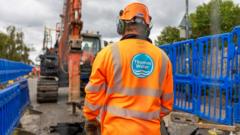
Thames Water, which serves the most customers — some 16 million — in the UK, has faced heavy criticism in recent years over its performance, sewage discharges, and pipe leaks.
The company, which supplies water and wastewater services mostly across London and parts of southern England, was handed a was handed a £122.7m fine in May last year, the biggest ever issued by the industry regulator Ofwat, for breaching rules on sewage spills and shareholder payouts.
A group of its existing lenders has offered to write off £9.4bn of its near £20bn debt pile and inject billions in new money, but want leniency from future pollution fines in return.
London & Valley Water (L&VW), a consortium of large financial institutions and investors, said some £3.35bn of cash would be put into the company along with a new £6.55bn debt facility. It would be part of a £10bn business plan until 2030.
Reynolds said on Tuesday that she did not want a scenario where Thames Water customers had to “pick up the bill for the company’s failures”.
She told reporters that the government “stands ready for all eventualities”, including temporary nationalisation.
Speaking in the House of Commons, Reynolds said she had “three particular concerns about the proposal: the unfair cost to customers, delays to vital infrastructure investments, and delays to environmental improvements”.
“There is an expectation in the proposal for customers to fund and therefore bear an undue cost for investment in the company,” she said.
“In addition, I’m not convinced about the proposal’s request to reduce performance standards and about the significant delay to vital infrastructure investments needed.”
She added she was “concerned that the long-term resilience of the water and wastewater systems may not be adequately protected”.
However, a spokesperson for L&VW said the group was “confident that our plan is by far the fastest route to improve outcomes for customers and the environment, without any government funding or any cost to taxpayers”.
The proposed deal was a “long-term solution that recognises the full extent of Thames Water’s problems”.
“All other routes offer significantly worse outcomes for customers and the environment. Our proposals do not anticipate any increase in customer bills beyond those set out by Ofwat,” they added.
“Creating further delay and transferring risk to the taxpayer with special administration is not the right answer. It will only delay the process of fixing Thames Water.”
Ofwat has been reviewing the proposal and a decision is expected this summer.
The regulator said it would review the letter from Reynolds and consider her views on the current proposal.
“Ofwat’s board has not made a decision on the proposal,” a spokesperson said.
“We continue to engage with London & Valley Water and are reviewing their plans carefully to assess whether they deliver a turnaround in the company’s operational performance and strengthen its financial resilience to the benefit of customers and the environment.”
Without a rescue deal agreed, Thames Water is set to run out cash within a matter of months and could collapse.
Thames Water reiterated on Tuesday that it believed a market-led solution was the best option for customers and the environment.
A spokesperson for the company said: “It is positive that the Secretary of State has provided feedback to Ofwat in relation to the London & Valley Water plan.
“We will continue working with all parties to reach an agreement that supports long-term financial stability.”
The government has previously said it would prefer “a market-based solution”, but would step in “if that were to become necessary”.
The form of temporary nationalisation on the table is known as a special administration regime (SAR), which ensures vital companies such as water, are kept running by government appointed managers.
Proponents of the SAR solution say that it would give Thames something of a fresh start, allowing it to write off some of its losses and be sold without such a large debt pile.
Get our flagship newsletter with all the headlines you need to start the day. Sign up here.