


22 hours ago
Tessa WongAsia digital reporter, at the Shangri-la Dialogue in Singapore
Reuters
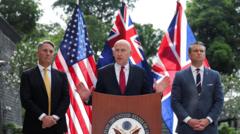
UK defence minister John Healey said the UK would be contributing £150m to the new project
The US, UK and Australia say they will develop underwater drone technology to protect undersea cables and boost defence, under their military alliance known as Aukus.
The uncrewed undersea vehicle (UUV) technology is expected to be ready by next year. While the project’s total cost was not stated, UK Defence Secretary John Healey said his nation would contribute £150m ($201m).
The announcement, made by the countries’ defence ministers at a security summit in Singapore, follows claims of slow progress in Aukus’s projects.
Acknowledging the criticism, Healey said “for too long in Aukus, we talked too much and delivered too little”, adding “that has now changed under our three governments”.
The Aukus defence pact, which began in 2021, affirmed the three countries would develop nuclear submarines and share military expertise.
It is widely seen as a way to counter China’s growing maritime presence in the Indo-Pacific and its role in rising tensions in disputed territories such as the South China Sea.
The UUV technology is the first signature project under Aukus’s Pillar Two, in which the partner countries work together on “advanced capabilities” in areas such as long-range hypersonic missiles, undersea robotics and AI.
A joint statement said the new project would see “cutting edge payloads and enabling systems” developed for UUVs that could protect seabed infrastructure, conduct strikes, and conduct surveillance, reconnaissance and logistics operations.
Healey also said that sensors and weapons systems would be developed for the UUVs, which would “rapidly give our forces advanced battle technologies”.
It would also help them deal with threats “including to our underwater cables and pipelines on which so much of our daily life depends”. Such efforts would strengthen deterrence in the Pacific, Atlantic and waters in the High North, he added.
The announcement comes a month after Healey accused Russia of running a covert operation over cables and pipelines in waters north of the UK. Moscow has denied the allegations.
The UK is connected by about 60 undersea cables, which British officials say are increasingly under threat from Moscow, with a 30% rise in Russian vessels spotted in UK waters over the past few years.
There have also been multiple reports of cables damaged in the Baltic Sea.
On Saturday, the three defence ministers did not respond to a question from the BBC on whether the UUV technology project was aimed at countering Russian and Chinese undersea activities.
They also did not answer a question on whether progress on Aukus projects was too slow.
Under Pillar One of the defence pact, nuclear-powered attack submarines would be built in the UK and Australia for use in their navies.
For Australia in particular, the deal represents a major upgrade to its military capabilities.
The country will become just the second to receive Washington’s elite nuclear propulsion technology after the UK, which began receiving it decades ago.
But questions have been increasingly asked in Australia about whether the country’s biggest-ever defence project could be achieved in time to replace their ageing submarines – or if at all.
The Aukus submarines are only scheduled to be ready in the 2040s. In the meantime, the US and UK will be rotating their existing nuclear-powered submarines through Australia, and in the 2030s Australia will buy second-hand nuclear submarines from the US.
Days before arriving in Singapore for the Shangri-la Dialogue, Australia’s Defence Minister Richard Marles addressed this criticism, saying they had to go ahead with the Aukus submarine project as there was no “plan B”.
On Saturday, US Defence Secretary Pete Hegseth said the plan to rotate US and UK nuclear-powered submarines through Australia was “still on track”, with the first US Navy personnel due to arrive later this year.
Marles said that the HMAS Stirling navy base in Western Australia would be ready to host the rotational submarine force by the end of 2027, and that “work is at a pace” to establish a construction yard in South Australia that would build the Aukus submarines.